
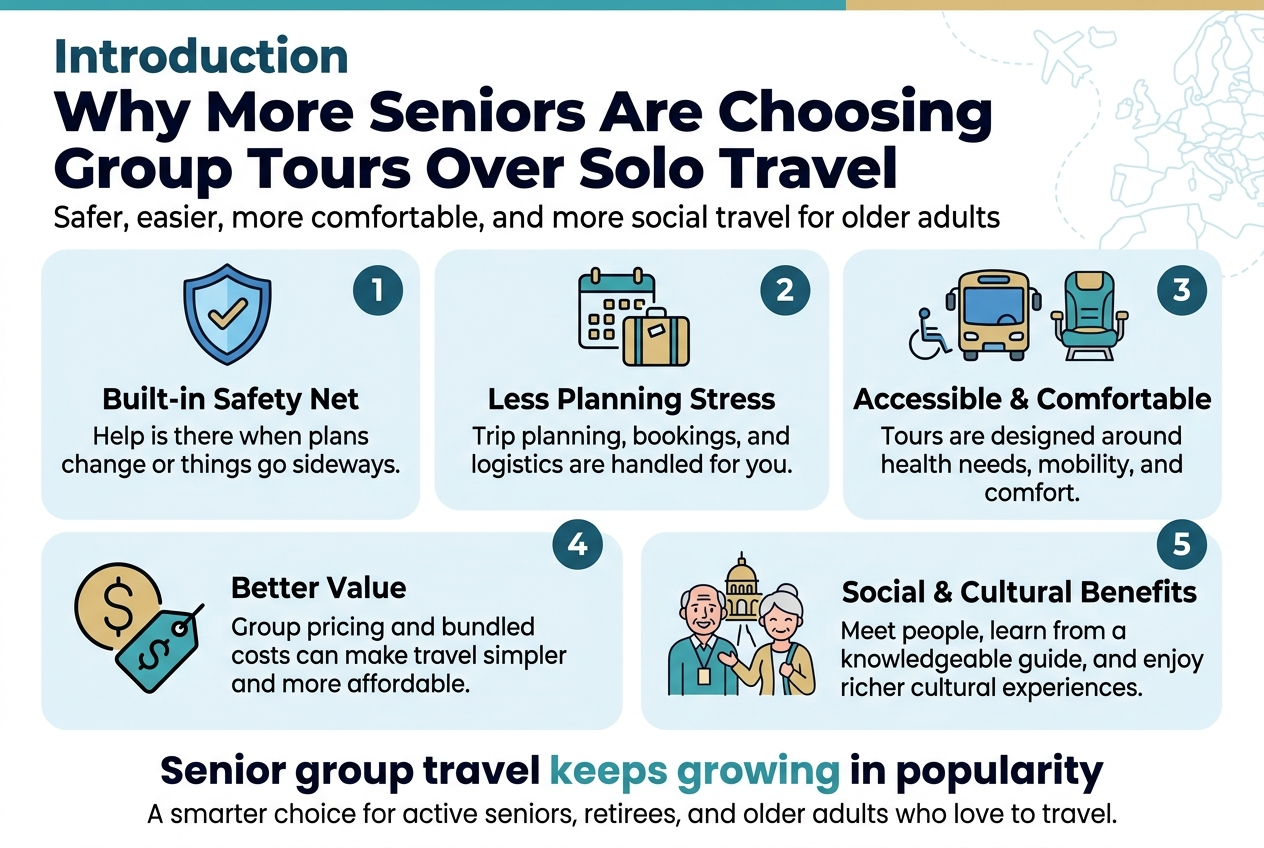
Why More Seniors Are Choosing Group Tours Over Solo Travel
If you’re a senior traveler wondering whether group tours are worth it, the short answer is yes — and the reasons go way beyond just having someone carry your luggage.
Group tours for seniors have become one of the smartest travel choices for older adults who want to see the world without the headaches that come with planning everything alone. This guide is written for active seniors, retirees, and older adults who love to travel but want a safer, more comfortable way to do it.
Here’s what we’ll dig into: how group tours act as a built-in safety net when things go sideways, why the stress of trip planning basically disappears when you book a guided tour, and how accessible tours for elderly travelers are now designed with real comfort and health needs in mind — not just as an afterthought.
We’ll also cover the financial side, the social perks, and why traveling with a knowledgeable guide opens doors to cultural tours for seniors that you simply can’t replicate on your own.
By the end, you’ll have a clear picture of why senior group travel keeps growing in popularity — and whether it might be the right fit for your next adventure.
Built-In Safety Net for Every Step of the Journey
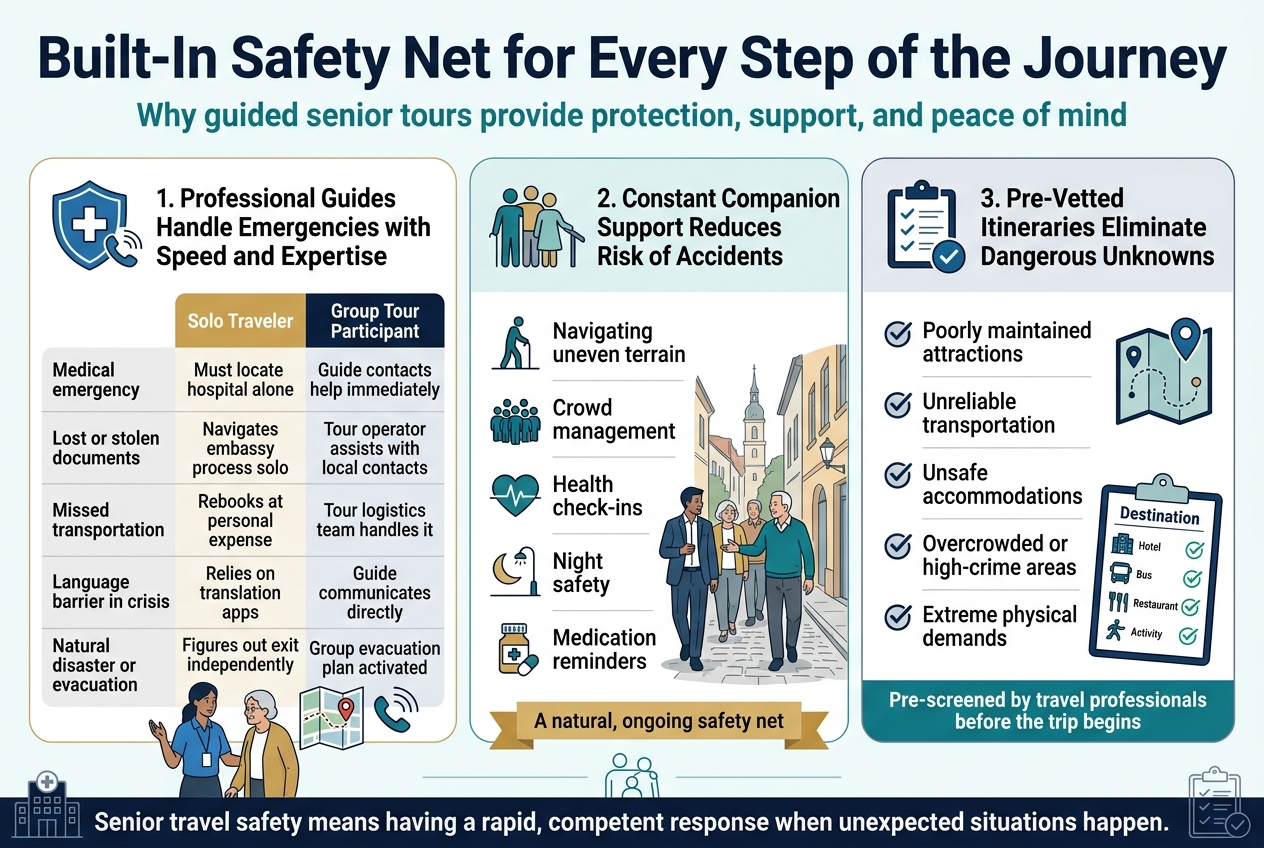
Professional Guides Handle Emergencies with Speed and Expertise
When something goes wrong during solo travel, you’re on your own — scrambling to find help in an unfamiliar place, possibly without knowing the local language. Group tours for seniors flip that script entirely. Experienced tour guides are trained to handle medical situations, sudden weather changes, transportation disruptions, and everything in between. They know which hospital is nearby, how to communicate with local emergency services, and exactly who to call when things go sideways.
Many reputable senior travel companies specifically hire guides with first aid certifications and emergency response training. These aren’t just people who know the best restaurants in Rome — they’re professionals who have managed real crises in real time. That kind of expertise is hard to put a price on when you’re 6,000 miles from home and something unexpected happens.
Here’s a quick look at how guided tours compare to solo travel during emergencies:
| Situation | Solo Traveler | Group Tour Participant |
|---|---|---|
| Medical emergency | Must locate hospital alone | Guide contacts help immediately |
| Lost or stolen documents | Navigates embassy process solo | Tour operator assists with local contacts |
| Missed transportation | Rebooks at personal expense | Tour logistics team handles it |
| Language barrier in crisis | Relies on translation apps | Guide communicates directly |
| Natural disaster or evacuation | Figures out exit independently | Group evacuation plan activated |
The difference is striking. Senior travel safety isn’t just about avoiding bad situations — it’s about having a rapid, competent response when they happen anyway.
Constant Companion Support Reduces Risk of Accidents
One of the quieter but very real risks for older adults traveling alone is simply the absence of someone watching out for them. A missed step on a cobblestone street, a dizzy spell in the afternoon heat, or confusion at a busy transit hub can escalate quickly when no one’s around.
Group tours for seniors naturally solve this problem. You’re surrounded by fellow travelers and at least one attentive guide throughout each day. If you trip, someone helps you up. If you’re moving slower than usual, the group adjusts. If you mention feeling off at breakfast, the guide takes note and keeps a closer eye.
This isn’t just emotional comfort — it’s practical accident prevention. Studies on older adult falls consistently show that the presence of a companion reduces both the likelihood of a fall and the severity of outcomes when one does occur.
Some specific ways constant companion support protects seniors on the road:
- Navigating uneven terrain: Someone’s always there to offer a steadying hand or flag a hazard ahead
- Crowd management: Busy markets and tourist spots can be disorienting; guides actively manage group movement
- Health check-ins: Guides and fellow travelers often notice when someone seems off before the person realizes it themselves
- Night safety: Evening activities are structured and supervised, reducing risks that come with navigating unfamiliar areas after dark
- Medication reminders: Some tour operators offer gentle check-ins for travelers managing regular medications
The social fabric of a group tour creates a natural, ongoing safety net — without making anyone feel like they’re being managed or watched over in a patronizing way.
Pre-Vetted Itineraries Eliminate Dangerous Unknowns
Here’s something that doesn’t get talked about enough: a huge chunk of travel risk comes from the unknown. Wandering down an unfamiliar street, choosing a restaurant that looks fine but isn’t, booking a local boat tour without checking safety ratings — these are the kinds of judgment calls that can go wrong in ways you’d never anticipate.
Guided tours for older adults remove most of these unknowns before the trip even starts. Every destination, transportation mode, restaurant, hotel, and activity has already been evaluated by travel professionals who know exactly what to look for. They’ve walked the sites, tested the accessibility, vetted the local operators, and identified the potential risks.
What does a pre-vetted itinerary actually protect you from?
- Poorly maintained attractions: Some sites look beautiful in photos but have crumbling pathways, no handrails, or extreme terrain that isn’t appropriate for older adults
- Unreliable transportation: Local drivers or boats without proper safety certifications are a genuine hazard that an experienced operator knows to avoid
- Unsafe accommodations: Hotels are chosen not just for comfort but for location safety, accessibility features, and proximity to medical facilities
- Overcrowded or high-crime areas: Tour operators track local conditions and route travelers away from areas with known safety concerns
- Extreme physical demands: Activities are matched to the group’s realistic fitness and mobility levels, not just what sounds exciting in a brochure
Best travel options for seniors always include this layer of professional curation. You’re not just buying a schedule — you’re buying the peace of mind that comes from knowing someone who knows the destination deeply has already thought through the risks so you don’t have to.
No More Stressful Trip Planning
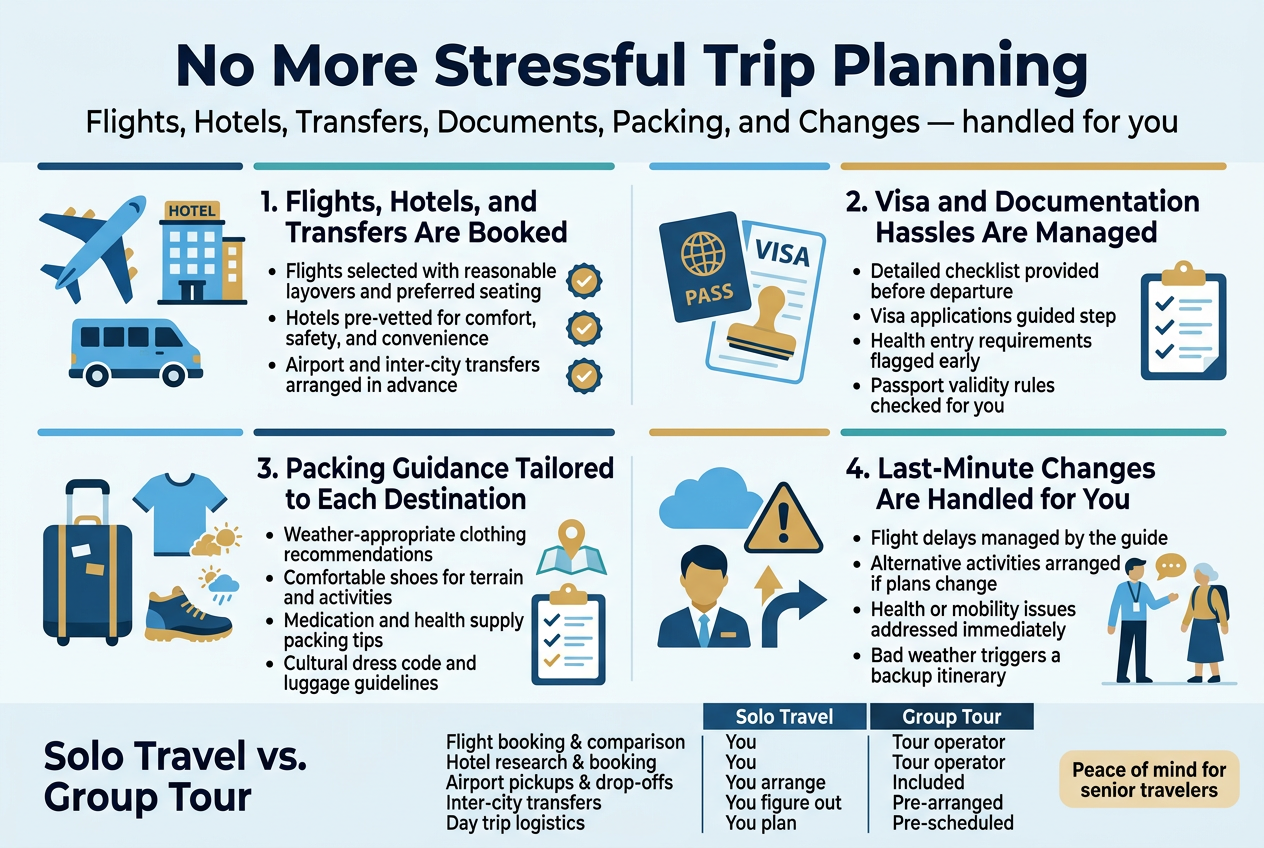
Flights, Hotels, and Transfers Are Booked for You
One of the biggest headaches of travel is the sheer amount of coordination it takes before you even leave your driveway. For seniors who want to make the most of their travel years, group tours take that entire burden off your plate completely.
When you join a senior group travel program, a dedicated team of travel professionals has already mapped out every detail:
- Flights are selected with reasonable layover times, preferred seating when possible, and routes that minimize exhaustion
- Hotel accommodations are pre-vetted for comfort, safety, and proximity to tour activities
- Airport transfers are arranged so you’re never standing on a curb wondering how to get to your hotel in an unfamiliar city
- Day-to-day transportation between destinations is coordinated so the group moves together, on time, without anyone getting left behind
Here’s a quick look at what you handle solo versus what a guided tour for older adults handles for you:
| Task | Solo Travel | Group Tour |
|---|---|---|
| Flight booking & comparison | You | Tour operator |
| Hotel research & booking | You | Tour operator |
| Airport pickups & drop-offs | You arrange | Included |
| Inter-city transfers | You figure out | Pre-arranged |
| Day trip logistics | You plan | Pre-scheduled |
That’s not just convenient — it’s genuinely life-changing for travelers who have spent decades managing every small detail on their own.
Visa and Documentation Hassles Are Managed by Experts
Visa requirements can shift without warning. Entry rules vary by nationality, age, and even the purpose of your visit. Trying to track all of that on your own while also planning the rest of your trip is exhausting.
With group tours for seniors, the tour operator’s team stays on top of these requirements for every destination on the itinerary. They typically:
- Provide a detailed checklist of required documents well ahead of departure
- Walk you through visa applications step by step, or handle group visa arrangements where applicable
- Flag any health-related entry requirements, including vaccinations or health declarations
- Alert you to passport validity rules — many countries require six months of validity beyond your travel dates, something solo travelers often overlook until it’s too late
For seniors traveling internationally for the first time or returning after many years, these details can feel overwhelming. Having a knowledgeable team confirm that your paperwork is in order before you ever reach the airport removes an enormous source of anxiety.
Some tour operators even assign a dedicated pre-trip coordinator who answers your documentation questions directly, making sure no one arrives at the airport with a preventable problem.
Packing Guidance Tailored to Each Destination Is Provided
Packing for a trip to Southeast Asia is completely different from packing for a Mediterranean cruise or a Canadian Rockies tour. Climate, cultural norms, terrain, and planned activities all influence what you actually need to bring — and what you’ll regret dragging through three airports.
Reputable guided tours for older adults provide destination-specific packing guides that go well beyond a generic checklist. You’ll typically receive recommendations on:
- Weather-appropriate clothing broken down by specific regions and travel dates
- Comfortable walking shoes suited to the terrain, including advice on cobblestones, uneven paths, or beach destinations
- Medications and health supplies you should carry in your hand luggage versus checked bags
- Cultural dress codes for religious sites, formal dinners, or local customs
- Luggage weight and size guidelines that align with the transport being used throughout the tour
This kind of personalized guidance is especially valuable for stress-free travel for seniors, since overpacking or underpacking can genuinely affect your comfort and enjoyment day to day. Nobody wants to spend a week in Italy without a light layer for cooler evenings because the packing list didn’t mention it.
Many senior travel groups also offer packing webinars or pre-departure calls where experienced guides share insider tips that don’t make it into any standard travel blog.
Last-Minute Changes Are Handled Without Personal Stress
Travel rarely goes exactly as planned. Flights get delayed, weather rolls in, a local site closes unexpectedly, or a road becomes impassable. For solo travelers, each of these moments can spiral into hours of frantic phone calls, rebooking fees, and real anxiety.
In a group tour setting, that problem belongs to the tour operator and your guide — not you.
Here’s what that looks like in practice:
- A flight delay means your guide is already coordinating the next steps while you relax with your fellow travelers
- An unexpected site closure means an alternative experience is arranged, often one you wouldn’t have found on your own
- A health issue or mobility concern that pops up mid-trip is addressed immediately, with the guide advocating on your behalf with hotels, transport providers, or medical services
- Bad weather changes the day’s itinerary, and your group is rerouted to an equally engaging backup plan
For seniors who carry the weight of “what if something goes wrong,” this is one of the most underappreciated benefits of affordable senior group tours. The mental load of managing the unexpected doesn’t sit on your shoulders. It sits on a team of professionals who do exactly this for a living.
That peace of mind isn’t a small thing. It’s often the difference between a trip you enjoy fully and one where you spend half your energy worrying about what could go sideways.
Medical Support and Health Considerations Are Prioritized
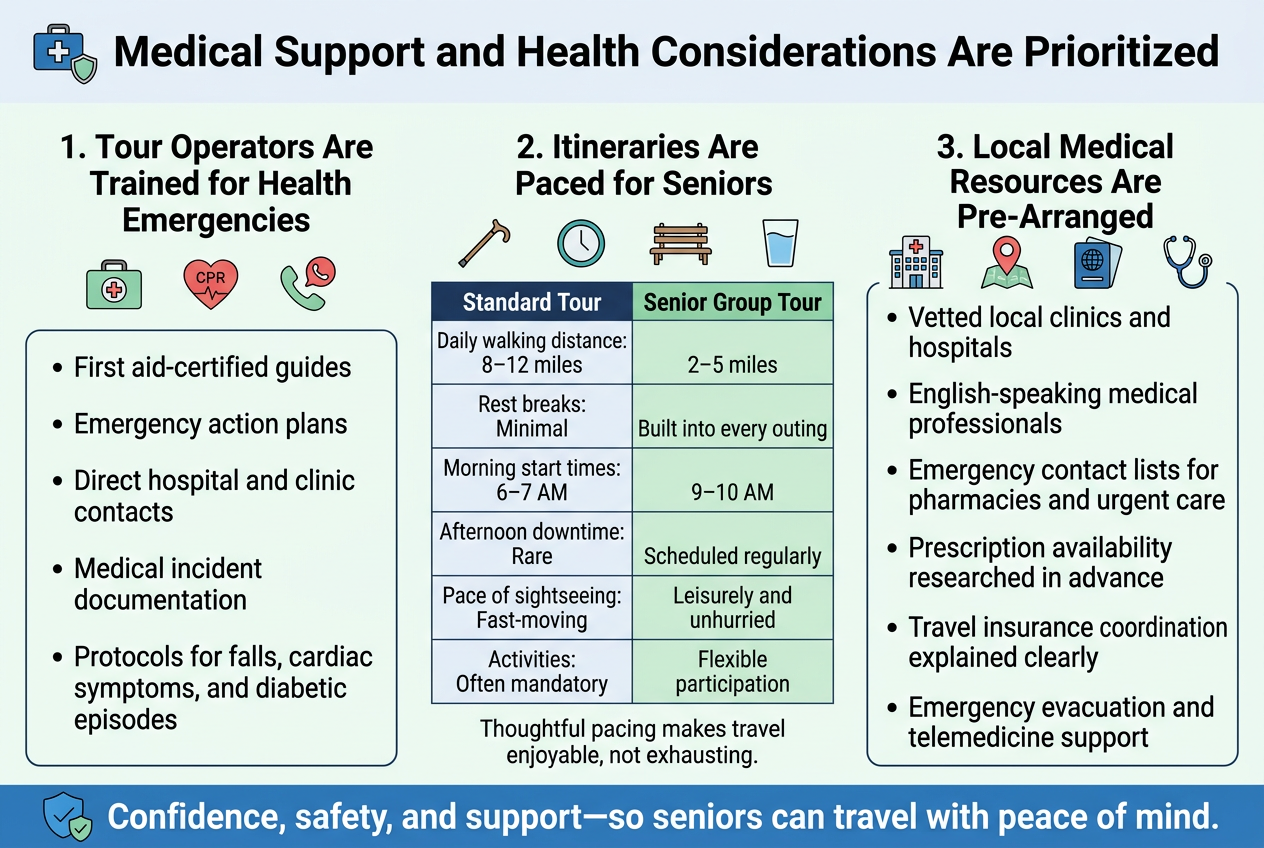
Tour Operators Are Trained to Assist With Health Emergencies
One of the biggest worries seniors and their families have about travel is: what happens if something goes wrong medically? With group tours for seniors, that question already has an answer before you even pack your bag.
Reputable tour operators who specialize in senior group travel put their guides and staff through training that goes well beyond knowing the best restaurants in Rome. Many tour leaders hold certifications in first aid and CPR. They know how to stay calm in a crisis, assess a situation quickly, and get the right help to the right person without panic or delay.
This matters more than most people realize. When a health situation pops up in an unfamiliar place, the difference between a scary moment and a serious tragedy often comes down to who is nearby and what they know. Having a trained travel companion who can step in immediately — rather than waiting for a stranger to call emergency services in a language you don’t speak — is one of the most underrated benefits of senior travel safety that group tours deliver.
Here’s what experienced tour operators typically have in place:
- First aid-certified guides on every departure
- Emergency action plans specific to each destination
- Direct communication lines with local hospitals and clinics
- Medical incident documentation to assist healthcare providers
- Protocols for common senior health events like falls, cardiac symptoms, or diabetic episodes
Itineraries Are Paced to Accommodate Seniors’ Physical Needs
One of the biggest complaints seniors have after travel — especially solo or with standard tours — is complete exhaustion. Too many miles on foot, too little rest time, and an overall pace that feels built for 25-year-olds with unlimited energy.
Group tours designed specifically for older adults flip that entirely. The daily schedule is built around what actually works for seniors’ bodies, not what looks impressive on a brochure.
What a senior-friendly itinerary typically looks like:
| Feature | Standard Tour | Senior Group Tour |
|---|---|---|
| Daily walking distance | 8–12 miles | 2–5 miles |
| Rest breaks | Minimal | Built into every outing |
| Morning start times | Early (6–7 AM) | Mid-morning (9–10 AM) |
| Afternoon downtime | Rare | Scheduled regularly |
| Pace of sightseeing | Fast-moving | Leisurely and unhurried |
| Optional vs. mandatory activities | Often mandatory | Flexible participation |
Beyond the schedule itself, guides on guided tours for older adults understand that some people need a moment to catch their breath at the top of a hill, that standing for long periods can be hard on knees and hips, and that a good seat and a glass of water mid-tour isn’t a luxury — it’s a necessity.
This kind of thoughtful pacing makes the entire experience genuinely enjoyable rather than something to simply survive. You come home feeling like you actually traveled, not like you ran a marathon in dress shoes.
The best travel options for seniors aren’t the ones that cram the most into every hour. They’re the ones that give you enough space to actually absorb where you are — to linger over a painting in a museum, to sit at a piazza and watch the world go by, to be present instead of perpetually rushing.
Access to Local Medical Resources Is Pre-Arranged
Getting sick or injured abroad and not knowing where to turn is genuinely frightening. Language barriers, unfamiliar healthcare systems, questions about insurance coverage — it can feel completely overwhelming in the moment.
Senior group travel benefits here are hard to overstate. Quality tour operators don’t just hope for the best. They do the groundwork long before your trip begins.
That means:
- Vetted local clinics and hospitals are identified at every stop on the itinerary
- Relationships with English-speaking medical professionals are established in advance
- Guides carry emergency contact lists with local emergency numbers, pharmacies, and urgent care facilities
- Information on local prescription availability is researched ahead of time for common medications
- Travel insurance coordination is either included or clearly explained so you know exactly what’s covered
Some senior-focused tour companies go even further by partnering with international medical assistance services that can arrange emergency evacuations, coordinate between your home physician and local doctors, or even provide telemedicine consultations during the trip.
For travelers managing chronic conditions — heart disease, diabetes, mobility challenges, respiratory issues — this level of preparation isn’t just a nice touch. It’s the reason they can travel at all with real confidence.
Accessible tours for elderly travelers are built on this kind of behind-the-scenes infrastructure. You might never need it. But knowing it’s there changes everything about how relaxed and free you feel on the road.
Financial Protection Keeps Your Investment Secure
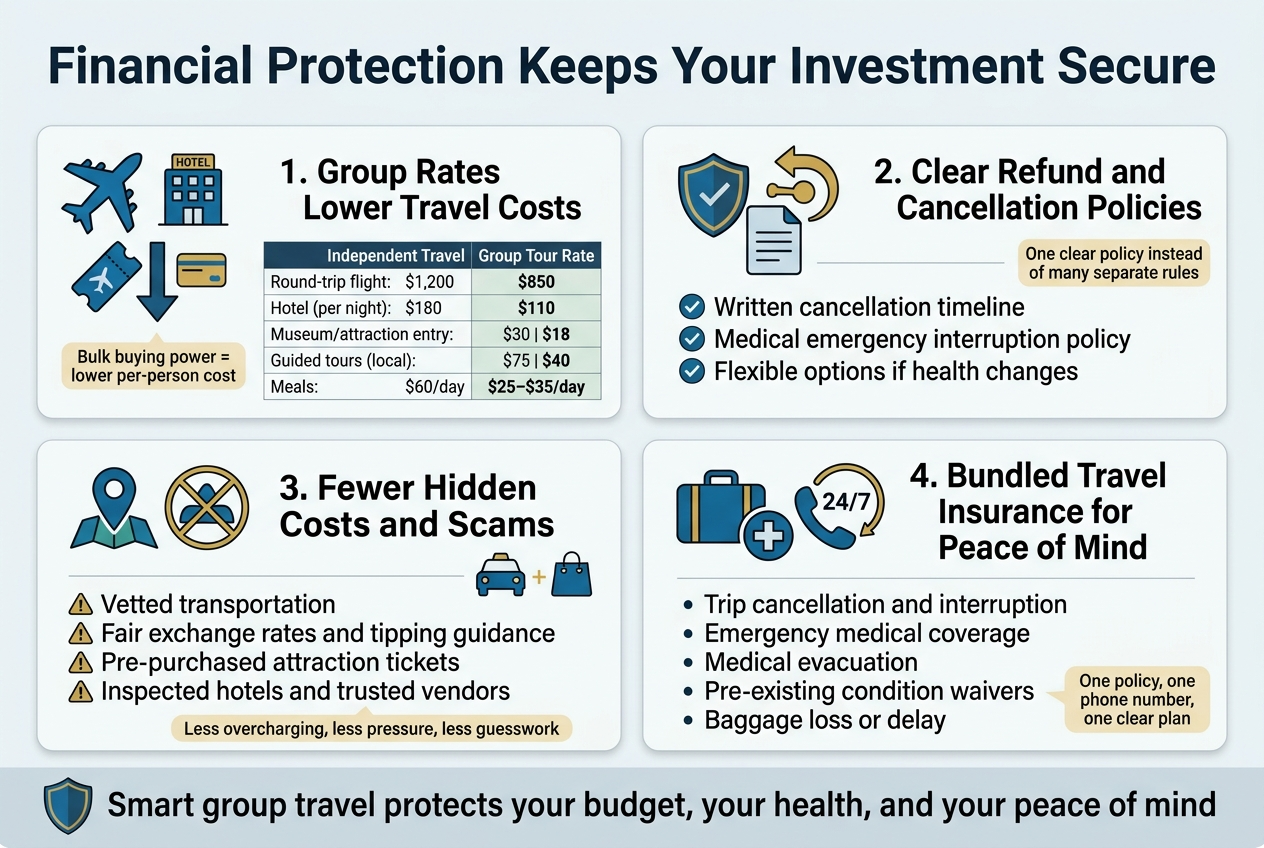
Group Rates Lower the Overall Cost of Travel Significantly
One of the most practical perks of affordable senior group tours is the sheer buying power that comes with traveling as part of a crowd. Tour operators negotiate bulk rates with airlines, hotels, restaurants, and attractions — savings that would be completely out of reach for a solo traveler or even a couple booking on their own.
Think about it this way: when a tour company books 30 hotel rooms at once, the hotel drops the nightly rate. When they fill an entire coach or block of airline seats, the per-person cost shrinks. Those savings get passed directly to you.
Here’s a rough comparison of what group travel pricing can look like versus independent travel:
| Expense | Independent Travel (Estimate) | Group Tour Rate (Estimate) |
|---|---|---|
| Round-trip flight | $1,200 | $850 |
| Hotel (per night) | $180 | $110 |
| Museum/attraction entry | $30 | $18 |
| Guided tours (local) | $75 | $40 |
| Meals (included or discounted) | $60/day | $25–$35/day |
The numbers add up fast — and not in the solo traveler’s favor. For seniors on a fixed income or budget, this kind of structured savings makes group tours for seniors not just a smart choice, but often the most financially sensible one.
Reputable Operators Offer Reliable Refund and Cancellation Policies
When you book a trip independently, cancellation policies can be a minefield. Airlines, hotels, and local vendors all have different rules. Miss one deadline and you could lose hundreds — sometimes thousands — of dollars.
Reputable guided tours for older adults bundle everything under a single, clearly written cancellation policy. You know upfront:
- What happens if you need to cancel — and how much of your money you get back
- What happens if the tour is canceled — many operators offer full refunds or credit toward future trips
- Deadlines that are actually readable — no buried fine print in three-point font
Organizations like Road Scholar, Tauck, and Viking River Cruises (among others) have built their reputations on transparent policies because their core audience — seniors — demands it. They can’t afford to play games with people’s retirement savings.
Before booking, always look for:
- A written cancellation timeline with clear refund percentages
- A policy for trip interruption due to medical emergencies
- Flexibility options if your health situation changes before departure
A trustworthy operator treats your money with the same care you do. If a company can’t clearly explain what happens to your payment when things go wrong, that’s a red flag worth taking seriously.
Hidden Costs and Scams Are Far Less Likely
Solo travelers — especially in unfamiliar countries — are prime targets for overcharging, tourist traps, and outright scams. Unlicensed taxis, inflated restaurant tabs, unofficial “guides” who demand large tips, counterfeit goods sold as authentic souvenirs — the list goes on.
When you travel with a reputable group, a lot of that exposure disappears. Your tour director has been to these destinations before. They know which vendors are trustworthy, which restaurants have fair pricing, and which “must-see” stops are actually commission-driven detours designed to separate you from your cash.
Here’s what group travel protects you from financially:
- Unlicensed transportation — your group travels in pre-arranged, vetted vehicles
- Currency confusion — guides help you understand local exchange rates and tipping customs
- Overpriced attractions — group tickets are pre-purchased at proper rates
- Pressure sales tactics at markets or shops — you’re surrounded by fellow travelers, not isolated
- Fake or substandard accommodations — your hotel has already been inspected and verified
For seniors who may be less familiar with a destination’s local scams, or who simply don’t want the mental load of staying vigilant every single moment, traveling with a group is genuinely one of the best travel options for seniors when it comes to keeping your wallet safe.
Travel Insurance Options Are Bundled for Added Peace of Mind
Travel insurance is one of those things everyone knows they should have and almost nobody enjoys shopping for. When you go it alone, you’re left comparing dozens of policies — trip cancellation coverage, medical evacuation, lost luggage, pre-existing condition waivers — and hoping you pick the right one.
Many senior group travel operators either include travel insurance in the package price or have negotiated group insurance rates that are significantly cheaper than what you’d find booking individually.
Some of the key coverages to look for in a bundled policy include:
- Trip cancellation and interruption — reimbursement if you have to cancel before or during the trip
- Emergency medical coverage — especially critical for international travel where your domestic health insurance may not apply
- Medical evacuation — this one is genuinely expensive if you need it on your own; group plans often cover it at no extra cost
- Pre-existing condition waivers — many group operators work with insurers who cover stable pre-existing conditions when certain booking deadlines are met
- Baggage loss or delay — straightforward but easy to overlook
Some tour companies go even further by including 24/7 emergency assistance hotlines, connecting you directly with medical or travel support staff no matter the hour or time zone.
For seniors managing chronic conditions or simply wanting a financial safety cushion, this bundled approach removes the guesswork entirely. You’re not cobbling together coverage from three different providers — you have one policy, one phone number, and one clear plan if something goes sideways.
Social Connection Combats Loneliness on the Road
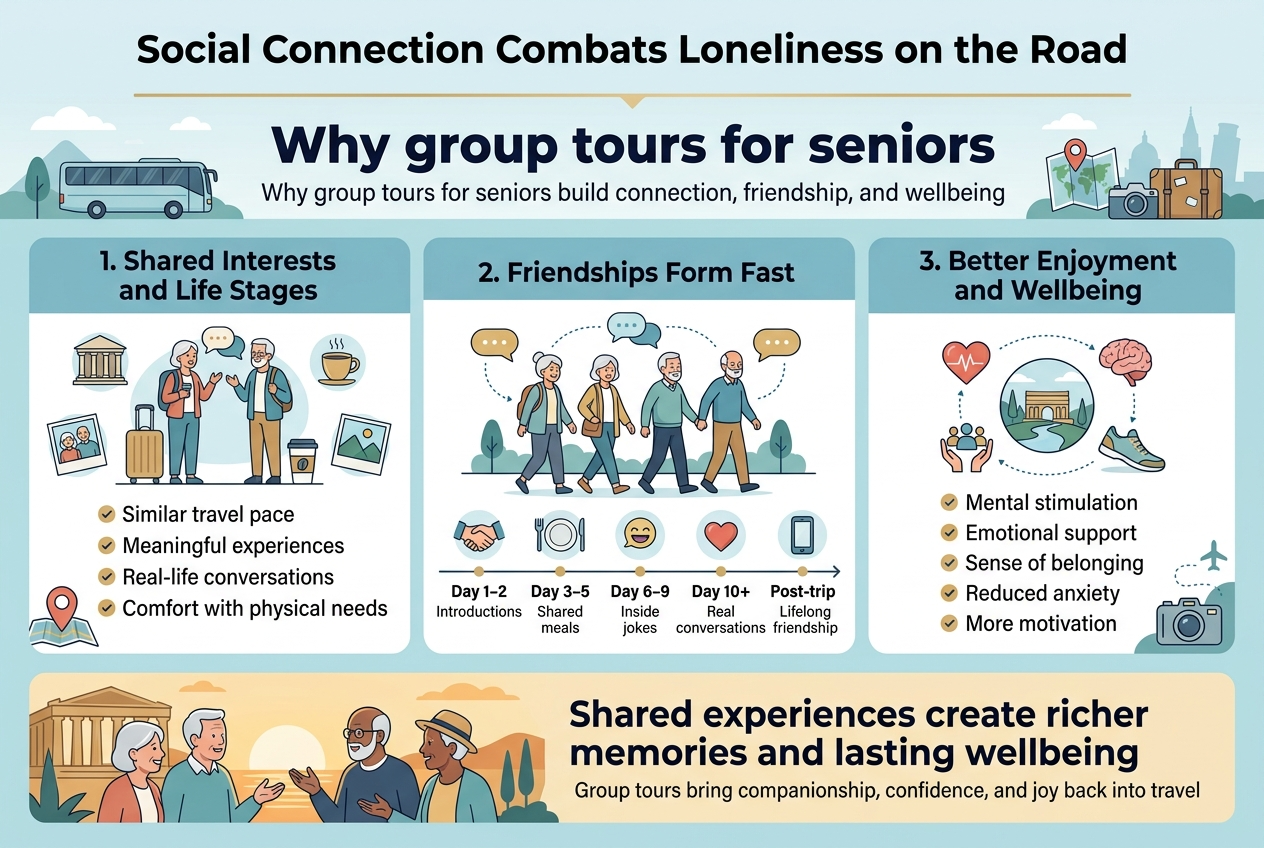
Travel Companions Share Similar Interests and Life Stages
One of the most quietly powerful benefits of group tours for seniors is that you’re never surrounded by strangers for long. When you step onto that tour bus or gather for a welcome dinner, the people around you have walked remarkably similar paths. They’ve raised families, built careers, weathered life’s curveballs, and now they’re ready to see the world. That shared context creates an almost instant sense of comfort and belonging.
Senior group travel brings together people who:
- Prefer a similar travel pace — no rushing through museums or sprinting to catch a train
- Appreciate meaningful experiences over social media moments
- Enjoy conversations rooted in real life experience — history, family, culture, food
- Understand each other’s physical needs without anyone feeling like they’re slowing the group down
This isn’t accidental. Tour operators who specialize in cultural tours for seniors carefully design their groups with age-appropriate demographics in mind. You’re not competing with a 25-year-old backpacker’s energy. You’re traveling alongside people who genuinely get it — the early bedtimes, the need for a good cup of coffee in the morning, the desire to actually absorb a place rather than just photograph it.
That natural alignment means conversations flow easily. You might find yourself bonding over grandchildren at breakfast, swapping recommendations for knee braces by afternoon, and laughing over shared memories of a destination’s history by dinner. The common ground runs deep, and that depth makes every interaction feel genuine rather than forced.
Group Dynamics Create Lasting Friendships and Memories
There’s something almost magical about what happens when a group of people travel together through new experiences. Within days — sometimes even hours — the walls come down. You’ve navigated a busy train station together, marveled at the same ancient ruins, or laughed through a cooking class gone slightly sideways. Those shared moments bond people in ways that ordinary social settings simply can’t replicate.
Senior travel companions who meet on guided tours regularly stay in touch long after returning home. It’s not unusual for tour groups to:
- Exchange contact information on day two of a ten-day trip
- Plan future trips together as a self-organized group
- Maintain years-long friendships through calls, letters, and visits
- Meet up at local events or share holiday cards decades later
The structured nature of group tours actually helps these friendships develop more naturally. You spend meaningful time together — not just a cocktail hour — but full days of shared discovery. You see each other navigate frustration, wonder, exhaustion, and joy. That’s the kind of exposure that builds real connection.
Many seniors who travel solo or with just a spouse report that group tours gave them an entirely new social circle at a time in life when making new friends can feel challenging. Retirement, the loss of a spouse, or children living far away can quietly shrink a person’s world. A single two-week senior group travel experience can blow that world wide open again.
Here’s how group tour friendships typically develop over a typical trip:
| Trip Stage | Social Dynamic |
|---|---|
| Day 1–2 | Introductions, polite small talk, learning names |
| Day 3–5 | Shared meals and excursions break the ice completely |
| Day 6–9 | Inside jokes, favorite travel partners emerge |
| Day 10+ | Real conversations, personal stories, genuine bonds |
| Post-trip | Ongoing contact, reunion planning, lifelong friendship |
The timeline moves fast because the experiences are intense and meaningful. You’re not making small talk at a neighborhood barbecue — you’re watching the sun rise over ancient temples together.
Shared Experiences Enhance Enjoyment and Overall Wellbeing
Research has consistently shown that social connection is one of the strongest predictors of health and happiness in older adults. Loneliness and isolation have real physical consequences — they’re linked to higher rates of cognitive decline, heart disease, and depression. Group tours for seniors quietly address all of this by building social engagement directly into the travel experience.
When you share an experience with others, you enjoy it more. That’s not just a feeling — it’s backed by psychology. Seeing the Colosseum for the first time is breathtaking. Seeing it alongside a group of people who are equally awestruck, then talking about it over dinner, then laughing about the moment someone nearly got left behind — that’s a memory that lives in you differently. Shared experiences create richer, more layered recollections that stay vivid for years.
The wellbeing benefits of senior travel companions on group tours include:
- Mental stimulation from engaging conversations with new people
- Emotional support when travel gets tiring or uncomfortable
- A sense of belonging that carries over well beyond the trip itself
- Increased motivation to stay active and plan future adventures
- Reduced anxiety because you’re never truly alone in an unfamiliar place
There’s also a gentle accountability that comes with traveling in a group. When someone in the group is enthusiastic about an optional excursion, their energy is contagious. You might push yourself to explore a little further, try a new food, or strike up a conversation with a local — and you’d do it because the group makes it feel safe and fun rather than overwhelming.
For seniors who’ve experienced loss — a spouse, close friends, or a sense of daily purpose — stress-free travel for seniors through a well-organized group tour can reignite a genuine excitement for life. The combination of novelty, beauty, and human connection is genuinely restorative. People come home from these trips with stories, photographs, new contacts in their phones, and an energy that their families often notice immediately.
That kind of return on a travel investment is hard to measure, but anyone who’s experienced it knows exactly what it’s worth.
Accessibility and Comfort Are Built Into the Experience
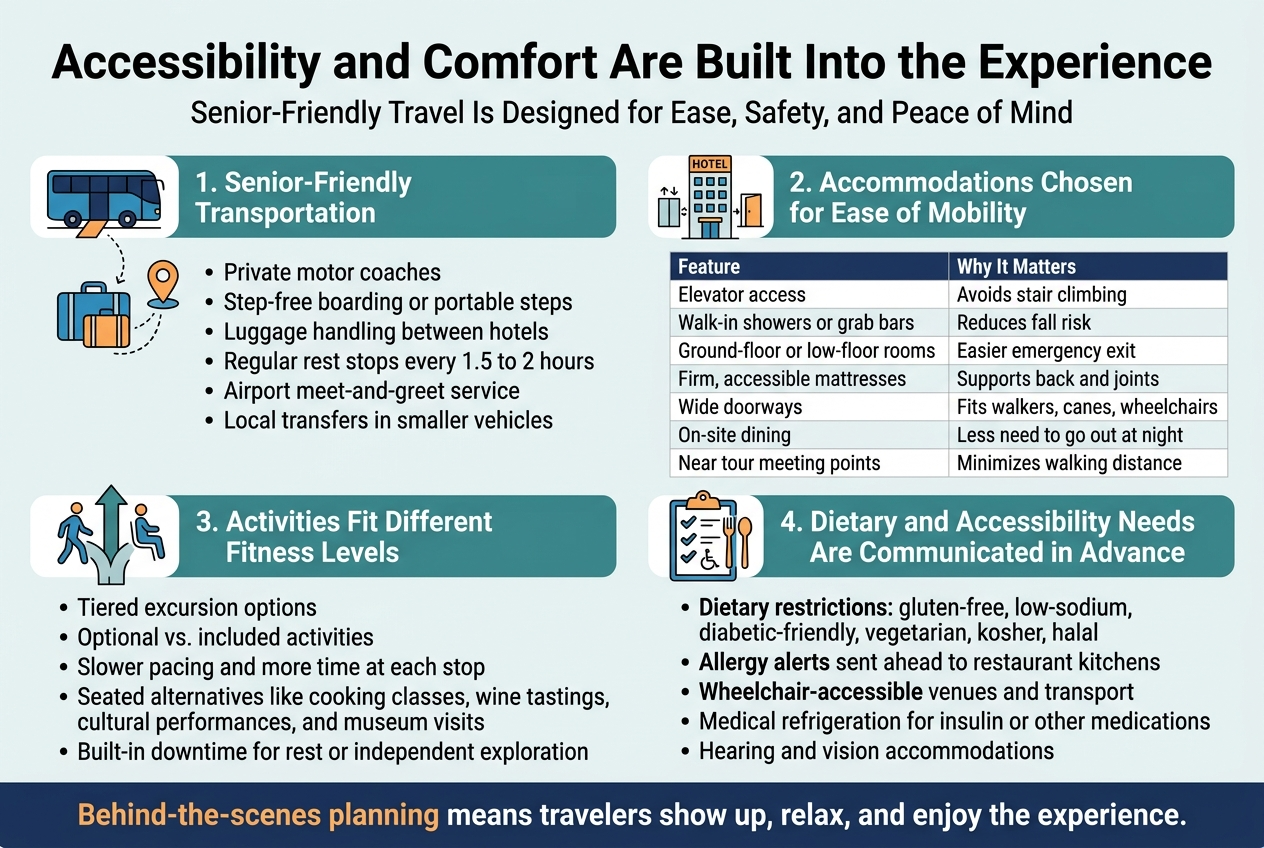
Senior-Friendly Transportation Is Arranged Throughout
Getting from point A to point B shouldn’t feel like an Olympic event. In accessible tours for elderly travelers, every leg of the journey — airport transfers, city-to-city coaches, local excursions — is handled with older adults in mind. That means comfortable, climate-controlled coaches with wide seats, easy boarding steps or ramps, and scheduled rest stops built into longer drives.
No scrambling for taxis in an unfamiliar city. No hauling luggage up subway stairs. No standing in long, confusing bus queues. Group tours for seniors take the chaos out of getting around, so you spend your energy enjoying the destination rather than surviving the transit.
Here’s what senior-friendly transportation typically looks like on a guided tour:
- Private motor coaches with cushioned, reclining seats and ample legroom
- Step-free boarding or portable steps with handrails for easy entry and exit
- Luggage handling — your bags are moved for you between hotels
- Regular rest stops every 1.5 to 2 hours on long drives
- Airport meet-and-greet services so you’re never wandering alone with your bags
- Local transfers in smaller vehicles when navigating tighter city centers
Tour operators who specialize in senior group travel know that transportation comfort isn’t a luxury — it’s a baseline requirement.
Accommodations Are Selected for Ease of Mobility
Where you sleep matters just as much as where you go. The best travel options for seniors on guided tours aren’t just chosen for their star ratings — they’re chosen because they work for older bodies and varying mobility levels.
Tour operators put significant effort into vetting hotels before they make the final cut. That vetting goes well beyond checking whether the pool looks nice in photos.
What operators look for in senior-appropriate accommodations:
| Feature | Why It Matters for Seniors |
|---|---|
| Elevator access to all floors | Avoids stair climbing after long days of sightseeing |
| Walk-in showers or grab bars | Reduces fall risk in the bathroom |
| Ground-floor or low-floor room options | Easy exit in case of emergency |
| Firm, accessible mattresses | Better for back and joint health |
| Wide doorways | Accommodates walkers, canes, or wheelchairs |
| On-site dining | Reduces the need to venture out late at night |
| Proximity to tour meeting points | Minimizes walking distance to group activities |
Many accessible tours for elderly travelers also pre-request specific room features on your behalf — like a walk-in shower, a ground floor room, or a firm mattress — so your needs are met before you even check in.
Activity Options Accommodate Varying Fitness Levels
One of the biggest concerns seniors have about joining a group tour is feeling like they’ll be left behind or holding others up. The reality with well-designed guided tours for older adults is that this almost never happens — because the itinerary is built with a range of fitness levels in mind from the start.
Good tour operators don’t build itineraries around the fittest person in the group. They build them around the whole group, with options layered in for those who want to push a little harder or take it easier.
How activity flexibility typically works on senior group tours:
- Tiered excursion options — one group hikes a trail while another takes a scenic drive to the same viewpoint
- Optional vs. included activities — some excursions are available for those who want them, without pressure on those who’d rather rest
- Slower pacing — itineraries for senior groups are deliberately less rushed, with more time at each stop
- Seated alternatives — cooking classes, wine tastings, cultural performances, and museum visits replace strenuous physical activities
- Built-in downtime — afternoons are often kept free so travelers can nap, explore at their own pace, or simply sit in a café
The best senior travel companions — both human and organizational — understand that rest isn’t weakness. It’s smart traveling. A good afternoon break means more energy for dinner and evening events, which are often the most memorable parts of any trip.
Dietary and Accessibility Needs Are Communicated in Advance
This is one of those details that separates a good tour from a great one. When you book a stress-free senior group tour with a reputable operator, your dietary restrictions and accessibility requirements don’t get noted on a sticky note somewhere and forgotten. They travel with you — communicated to every hotel, restaurant, and venue on the itinerary before you arrive.
Common needs that reputable tour operators handle proactively:
- Dietary restrictions — gluten-free, low-sodium, diabetic-friendly, vegetarian, kosher, halal
- Allergy alerts — communicated directly to restaurant kitchens ahead of group dining
- Mobility equipment — operators coordinate wheelchair-accessible venues and transport
- Medical refrigeration — hotels are pre-informed if insulin or other medications need cold storage
- Hearing or vision accommodations — guides adjust their communication style and group positioning accordingly
When these needs are communicated in advance, you don’t have to explain yourself at every meal or feel like a burden on the group. Everything is already taken care of.
This kind of behind-the-scenes preparation is one of the most underappreciated benefits of senior group travel. It means you show up, enjoy the experience, and trust that the details have been handled — because they have been.
Trusted Expertise Unlocks Richer Cultural Experiences
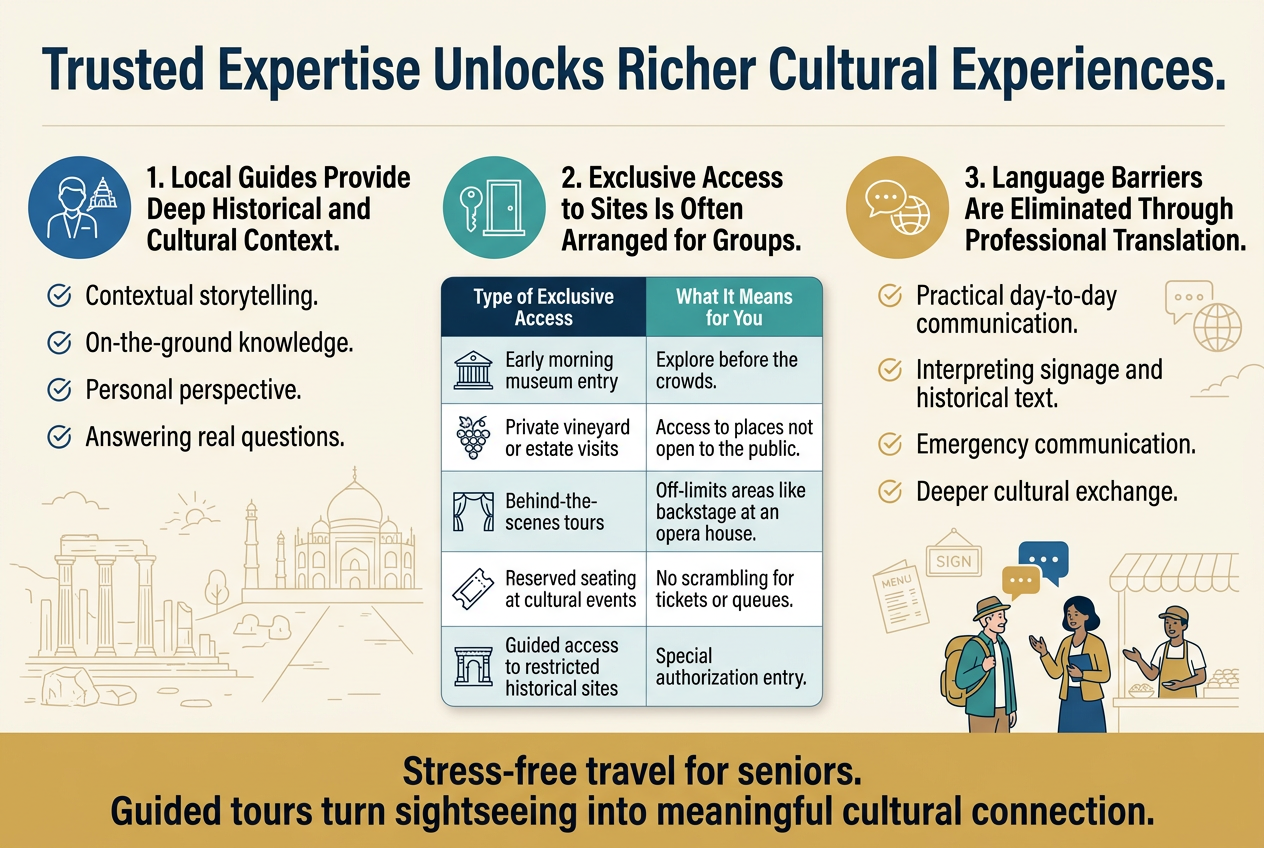
Local Guides Provide Deep Historical and Cultural Context
There’s a real difference between reading a plaque on a wall and having someone bring history to life right in front of you. That’s exactly what happens on cultural tours for seniors led by expert local guides. These aren’t just people holding umbrellas and pointing at buildings — they’re storytellers, historians, and passionate locals who know their city or region inside and out.
When you travel with a knowledgeable guide, you get layers of context that no travel book or smartphone app can fully replicate. Imagine standing in the ruins of a Roman amphitheater while someone explains exactly what daily life looked like for the people who sat in those seats two thousand years ago. Or walking through a Japanese temple district as your guide shares personal family stories tied to the local traditions. That kind of connection turns a sightseeing trip into something genuinely memorable.
For older adults who’ve spent decades being curious about the world, this depth of learning is one of the most rewarding parts of travel. Guided tours for older adults are specifically designed to honor that curiosity — building in time to ask questions, explore slowly, and really absorb what you’re seeing rather than rushing from one photo opportunity to the next.
Here’s what sets local expertise apart:
- Contextual storytelling — guides weave together history, culture, religion, and daily life into narratives that actually stick with you
- On-the-ground knowledge — they know which neighborhood bakery has been making the same pastry recipe for 80 years, or where the best spot is to watch the sunset over the old city walls
- Personal perspective — a local guide’s lived experience brings warmth and authenticity that no pre-recorded audio tour can match
- Answering real questions — you can ask whatever you want in real time, and get thoughtful answers rather than scripted responses
Exclusive Access to Sites Is Often Arranged for Groups
One of the lesser-known perks of group tours for seniors is the kind of access that simply isn’t available to independent travelers. Tour operators spend years building relationships with cultural institutions, heritage sites, museums, and private estates — and those relationships translate into real benefits for the people on their tours.
Think about what that can look like in practice:
| Type of Exclusive Access | What It Means for You |
|---|---|
| Early morning museum entry | You get to explore famous galleries before the crowds arrive |
| Private vineyard or estate visits | Access to places that aren’t open to the general public |
| Behind-the-scenes tours | Areas off-limits to regular visitors, like backstage at an opera house |
| Reserved seating at cultural events | No scrambling for tickets or waiting in queues |
| Guided access to restricted historical sites | Permission to enter areas that require special authorization |
For seniors who want a travel experience that feels genuinely special rather than generic, this kind of access is a huge draw. You’re not just following the same path as every other tourist — you’re getting a curated, often deeply personal encounter with a place.
Many senior group travel itineraries are also designed around smaller group sizes, which makes exclusive access even more meaningful. There’s a big difference between squeezing through the Sistine Chapel with three hundred strangers and seeing it with a small, attentive group under the guidance of an expert who can actually speak without shouting.
Some tours even include sit-down dinners with local artisans, historians, or chefs — real conversations with real people who are passionate about their craft and culture. Those moments are the ones that stay with you long after the trip is over.
Language Barriers Are Eliminated Through Professional Translation
One of the biggest worries seniors have about international travel is the language gap. What happens if you need help, want to order something specific at a restaurant, or simply want to understand what you’re looking at? On an independent trip, navigating a language you don’t speak can be exhausting and sometimes genuinely stressful. On a guided tour for older adults, that concern disappears almost entirely.
Professional tour guides and translators handle communication seamlessly, so you’re never left guessing or feeling embarrassed about not knowing the local language. This matters in more ways than one:
- Practical day-to-day communication — ordering meals, shopping, asking for directions, reading menus — all handled
- Interpreting signage and historical text — plaques, exhibits, and local literature become fully accessible
- Emergency communication — if a health or safety issue arises, having someone fluent in the local language is invaluable
- Deeper cultural exchange — guides can translate not just words but cultural nuance, helping you understand jokes, customs, local sayings, and unwritten social rules
The emotional comfort this provides shouldn’t be underestimated. There’s a real sense of ease that comes from knowing you can ask a question and get an accurate answer, or that someone will speak up on your behalf if something goes wrong. For seniors traveling internationally for the first time, or returning to regions where they’ve previously felt linguistically lost, this is one of the most appreciated aspects of stress-free travel for seniors.
Beyond just bridging communication gaps, great interpreters and bilingual guides actually open doors to richer human connections. When you can engage meaningfully with a market vendor, a local family, or a cultural performer — even through a translator — the experience becomes something far more personal than just observing from a distance. That’s the kind of travel that turns a vacation into a genuine encounter with the world.
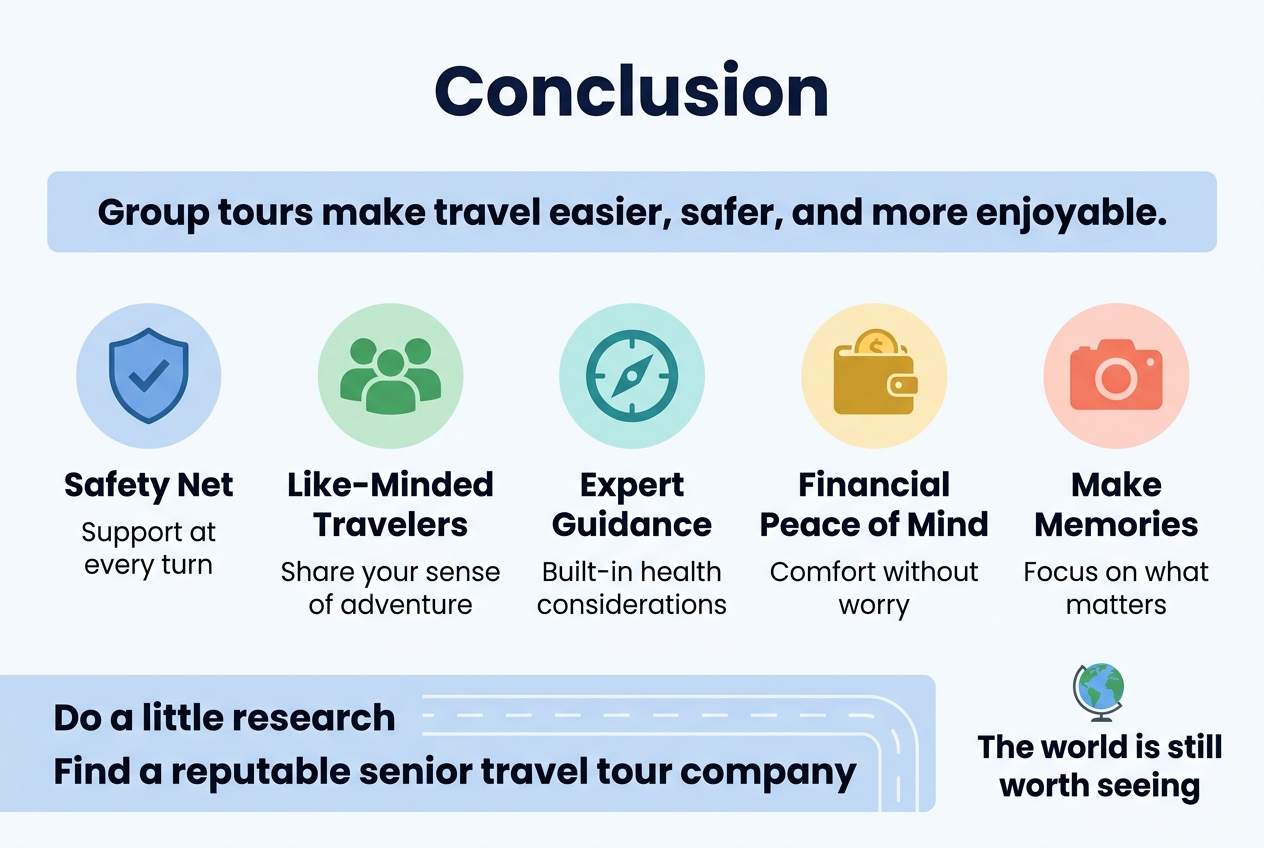
Group tours take the worry out of travel and replace it with pure enjoyment. From having a safety net at every turn to meeting like-minded people who share your sense of adventure, the benefits are hard to ignore. You get expert guidance, health considerations built right in, financial peace of mind, and a level of comfort that lets you focus on what actually matters — making memories.
If you’ve been on the fence about your next trip, a group tour might just be the smartest move you make. Do a little research, find a reputable tour company that specializes in senior travel, and take that trip you’ve been putting off. The world is still very much worth seeing, and you don’t have to figure it all out on your own.


