

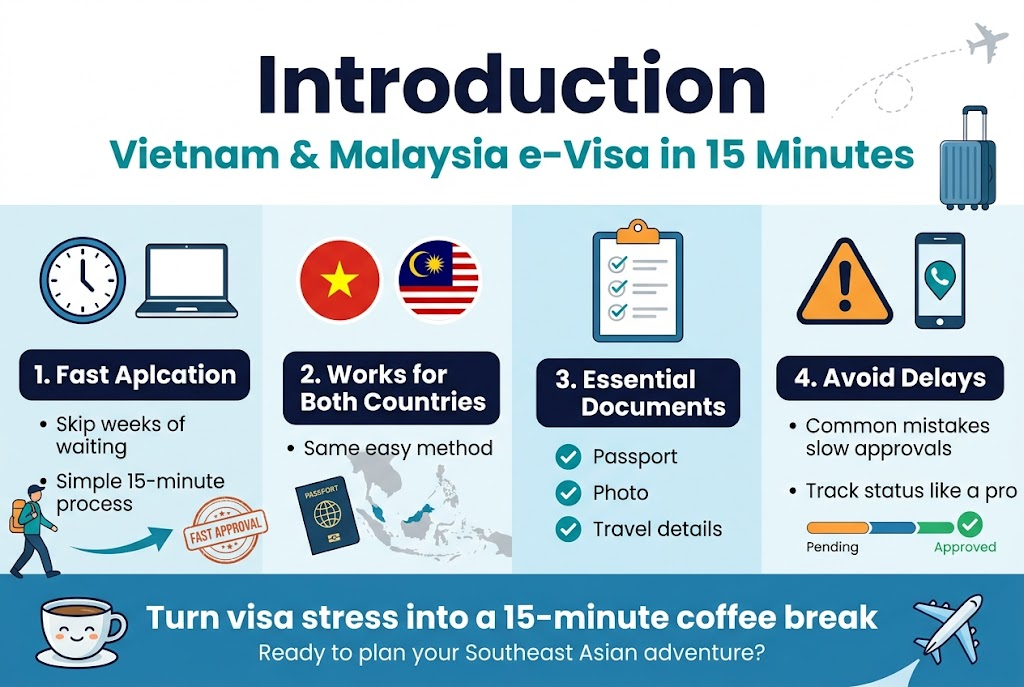
Getting a Vietnam or Malaysia e-visa used to mean waiting weeks and dealing with complicated paperwork. But there’s a simple 15-minute trick that gets your application approved almost instantly – and most Indian travelers have no idea it exists.
This guide is for Indian citizens who want to skip the visa hassles and start planning their Southeast Asian adventure. You’ll learn the exact steps that seasoned travelers use to breeze through the application process while others wait in digital queues.
We’ll walk through the lightning-fast application method that works for both countries, plus show you the essential documents checklist that prevents delays. You’ll also discover the biggest mistakes that slow down approvals and how to track your status like a pro.
Ready to turn visa stress into a 15-minute coffee break? Let’s dive in.
Understanding E-Visa Requirements for Indian Citizens
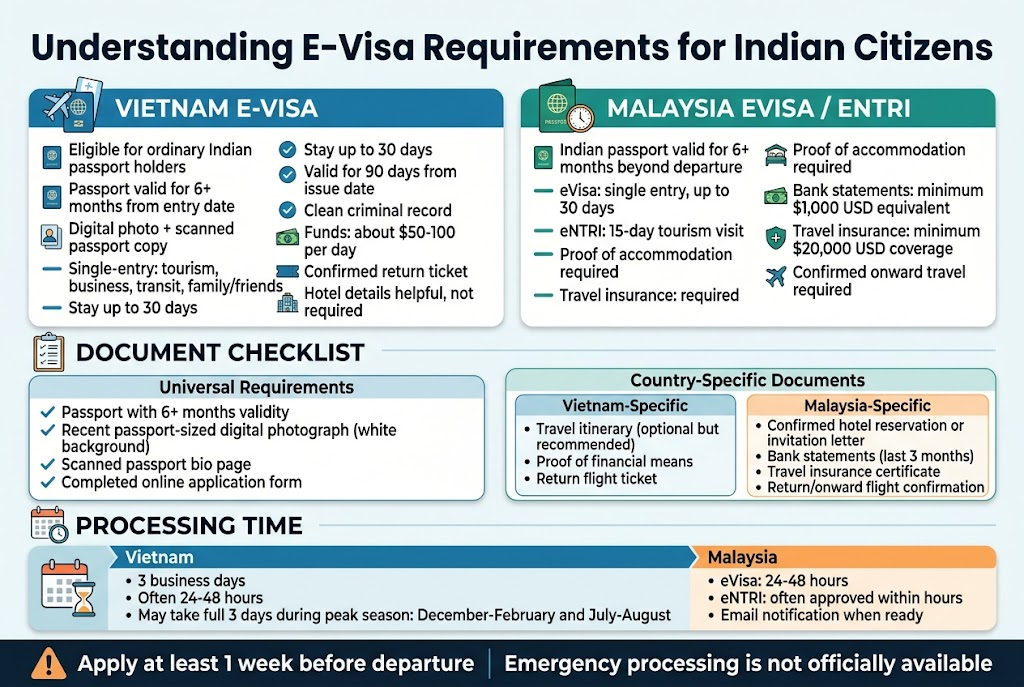
Vietnam E-Visa Eligibility Criteria for Indian Passport Holders
Indian citizens holding ordinary passports can apply for Vietnam’s electronic visa without visiting an embassy or consulate. Your passport needs at least 6 months validity from your planned entry date, and you must have a clear digital photo and scanned passport copy ready.
The Vietnam e-visa covers single-entry visits for tourism, business, transit, or visiting family and friends. You can stay up to 30 days, and the visa remains valid for 90 days from the issue date, giving you flexibility in planning your trip.
Key requirements include a clean criminal record, sufficient funds for your stay (around $50-100 per day), and a confirmed return ticket. Vietnam doesn’t require proof of accommodation booking, but having your hotel details ready speeds up the process.
Malaysia eVisa Qualification Standards for Indian Travelers
Malaysia offers multiple electronic visa options for Indian nationals. The eVisa (single entry) allows 30-day stays for tourism or business, while the eNTRI (electronic travel registration and information) permits 15-day visits specifically for tourism.
Your Indian passport must be valid for at least 6 months beyond your planned departure from Malaysia. Unlike Vietnam, Malaysia requires proof of accommodation (hotel bookings or invitation letters from Malaysian residents) and confirmed onward travel arrangements.
Financial requirements are stricter – you need bank statements showing sufficient funds (minimum $1,000 USD equivalent) for your entire stay. Malaysia also requires travel insurance with minimum coverage of $20,000 USD for medical expenses and emergencies.
Document Checklist for Both Countries
Both countries require similar basic documents with slight variations:
Universal Requirements:
- Passport with 6+ months validity
- Recent passport-sized digital photograph (white background)
- Scanned passport bio page
- Completed online application form
Vietnam-Specific:
- Travel itinerary (optional but recommended)
- Proof of financial means
- Return flight ticket
Malaysia-Specific:
- Confirmed hotel reservation or invitation letter
- Bank statements (last 3 months)
- Travel insurance certificate
- Return/onward flight confirmation
Processing Time Differences Between Vietnam and Malaysia
Vietnam processes e-visas within 3 business days, though many applications get approved within 24-48 hours during regular periods. During peak seasons (December-February and July-August), processing might extend to the full 3-day period.
Malaysia’s eVisa typically takes 24-48 hours for approval, making it slightly faster than Vietnam. The eNTRI option is even quicker, often approved within hours of submission. Both countries provide email notifications once your visa is ready for download.
Emergency processing isn’t officially available for either country, so apply at least one week before your planned departure to account for potential delays or document corrections needed.
Step-by-Step Vietnam E-Visa Application Process
Creating your online application account
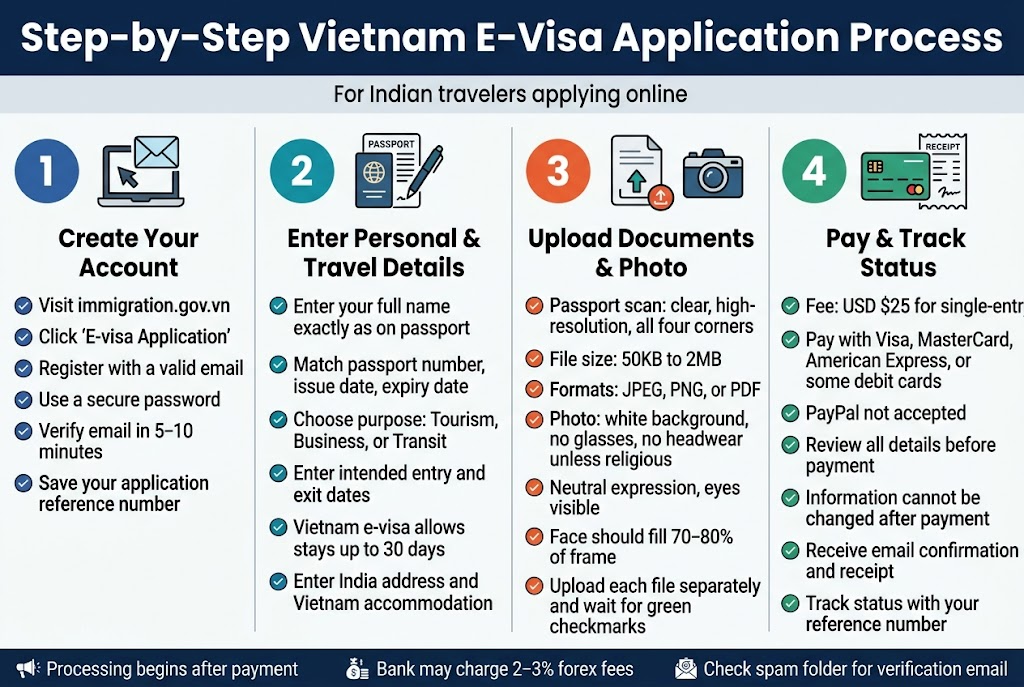
Visit the official Vietnam Immigration Services portal at immigration.gov.vn and click on “E-visa Application.” You’ll need to create a new account by providing a valid email address and creating a secure password. Make sure to use an email you check regularly since all communication about your application will come through this address.
After registering, you’ll receive a verification email within 5-10 minutes. Check your spam folder if you don’t see it immediately. Click the verification link to activate your account, then log back into the portal. The system will assign you a unique application reference number – save this number as you’ll need it to track your application status.
Filling out personal and travel information accurately
Start with the “Applicant Information” section. Enter your full name exactly as it appears on your passport – any mismatch can cause delays or rejection. Double-check spelling, spacing, and punctuation. Your passport number, issue date, and expiry date must match your physical passport precisely.
For travel details, select your purpose of visit from the dropdown menu. Tourism, business, and transit are the most common options for Indian travelers. Enter your intended entry and exit dates, keeping in mind that Vietnam e-visas allow stays up to 30 days. Your entry date should be at least 3 days from your application submission to account for processing time.
Provide your current address in India and your accommodation details in Vietnam. If you haven’t booked accommodation yet, you can enter the name and address of any hotel in your planned destination city – you’re not locked into staying there.
Uploading required documents and photos
Your passport scan should be clear, high-resolution, and show all four corners of the biographical page. The file size must be between 50KB and 2MB in JPEG, PNG, or PDF format. Scan or photograph your passport on a flat, white surface with good lighting to avoid shadows or glare.
The photo requirements are strict: white background, no glasses, no headwear (unless for religious purposes), neutral expression with mouth closed, and eyes clearly visible. Your face should occupy 70-80% of the photo frame. Most smartphone cameras work perfectly if you follow these guidelines. Avoid using old passport photos or ID photos as they often don’t meet the current specifications.
Upload each document separately and wait for the green checkmark confirming successful upload before moving to the next section. If uploads fail, try reducing file sizes or switching browsers.
Payment methods and fee structure
Vietnam e-visa costs USD $25 for single-entry applications. Payment options include major credit cards (Visa, MasterCard, American Express) and some international debit cards. PayPal is not currently accepted.
Before paying, review all information one final time. Once payment is processed, you cannot modify your application details. The system accepts payments in USD only, so your bank may apply foreign exchange charges. Most Indian banks charge 2-3% for international transactions.
After successful payment, you’ll receive an email confirmation with your payment receipt and application reference number. Processing begins immediately, and you can track status using the reference number on the immigration portal.
Complete Malaysia eVisa Application Guide
Selecting the correct visa category for your trip
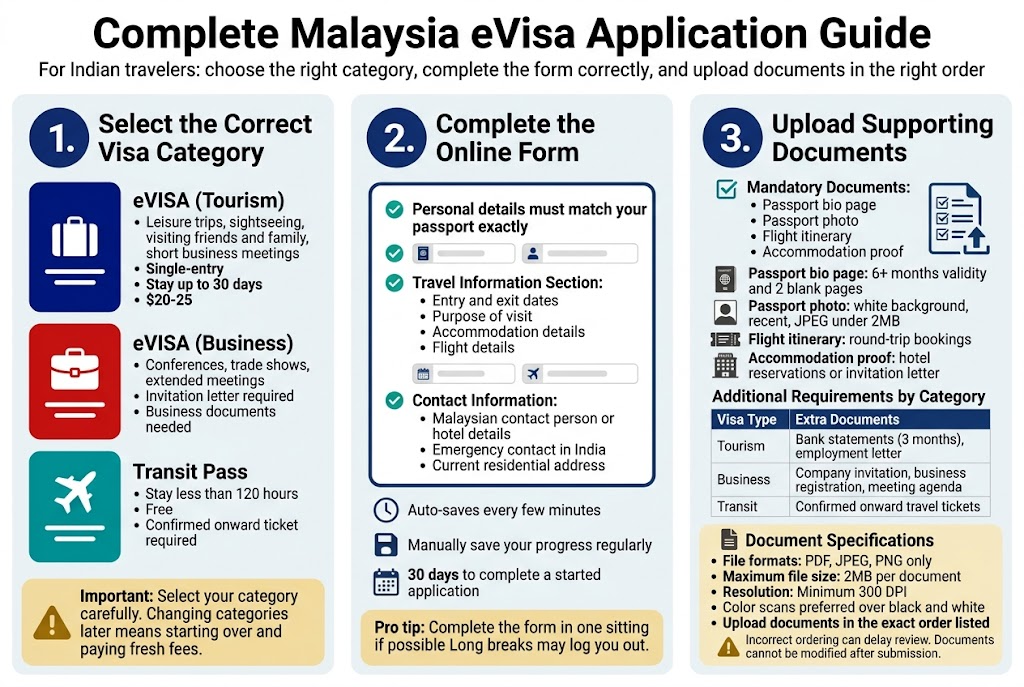
Malaysia offers different eVisa categories for Indian travelers, and picking the right one determines your application success. The eVISA (Tourism) covers most leisure trips, including sightseeing, visiting friends and family, or short business meetings. This single-entry visa allows stays up to 30 days and costs around $20-25.
Business travelers attending conferences, trade shows, or extended meetings should choose the eVISA (Business) category. You’ll need an invitation letter from the Malaysian company and additional documentation proving your business purpose.
Transit passengers staying less than 120 hours can opt for the Transit Pass, which is free but requires confirmed onward tickets. However, most Indians prefer the tourism eVisa for flexibility.
Important: Select your category carefully during application. Changing categories later means starting over with a new application and paying fresh fees.
Online form completion with travel details
The Malaysia eVisa application portal walks you through multiple sections requiring accurate information. Start with personal details matching your passport exactly – any spelling differences trigger automatic rejections.
Travel Information Section:
- Entry and exit dates (must be within visa validity)
- Purpose of visit (tourism, business, transit)
- Accommodation details (hotel bookings or host information)
- Flight details (booking confirmations work fine)
Contact Information:
- Malaysian contact person or hotel details
- Emergency contact in India
- Current residential address
The system auto-saves every few minutes, but manually save your progress regularly. You have 30 days to complete a started application before it expires.
Pro tip: Complete the form in one sitting if possible. The portal sometimes logs you out during long breaks, potentially losing unsaved information.
Supporting document submission requirements
Malaysia’s eVisa system requires specific documents uploaded as clear, colored scans. Poor quality uploads are the leading cause of rejections.
Mandatory Documents:
- Passport bio page: Must have 6+ months validity and 2 blank pages
- Passport photo: White background, recent (within 3 months), JPEG format under 2MB
- Flight itinerary: Round-trip bookings showing entry/exit dates
- Accommodation proof: Hotel reservations or invitation letter from host
Additional Requirements by Category:
| Visa Type | Extra Documents |
|---|---|
| Tourism | Bank statements (3 months), employment letter |
| Business | Company invitation, business registration, meeting agenda |
| Transit | Confirmed onward travel tickets |
Document Specifications:
- File formats: PDF, JPEG, PNG only
- Maximum file size: 2MB per document
- Resolution: Minimum 300 DPI for clear text reading
- Color scans preferred over black and white
Upload documents in the exact order listed on the portal. The system processes files sequentially, and incorrect ordering can delay review. Double-check each upload before proceeding – you cannot modify documents after submission without starting a new application.
Essential Documents and Photo Requirements
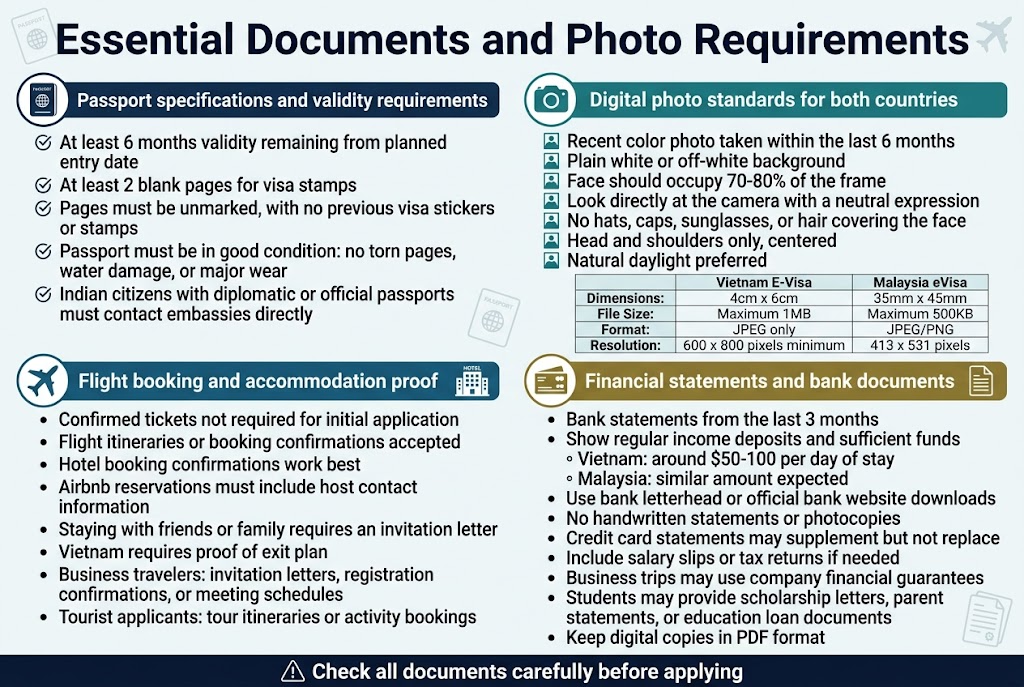
Passport specifications and validity requirements
Your passport needs at least six months of validity remaining from your planned entry date into both Vietnam and Malaysia. This isn’t negotiable – immigration officers will check this requirement strictly at arrival. The passport must have at least two blank pages for visa stamps, and these pages should be completely unmarked with no previous visa stickers or stamps.
For Vietnam, your passport should be in good condition without any torn pages, water damage, or significant wear. Malaysian authorities are equally strict about passport condition. If your passport looks worn or damaged, consider renewing it before applying for your e-visa to avoid rejection.
Indian citizens holding diplomatic or official passports follow different procedures and should contact the respective embassies directly rather than using the e-visa system.
Digital photo standards for both countries
Photo requirements can make or break your application. Both countries demand recent color photographs taken within the last six months. The background must be plain white or off-white with no shadows, patterns, or objects visible.
Your face should occupy 70-80% of the photo frame, looking directly at the camera with a neutral expression. No smiling, frowning, or mouth open. Remove glasses unless you wear them daily for medical reasons, and even then, ensure no glare appears on the lenses.
| Specification | Vietnam E-Visa | Malaysia eVisa |
|---|---|---|
| Dimensions | 4cm x 6cm | 35mm x 45mm |
| File Size | Maximum 1MB | Maximum 500KB |
| Format | JPEG only | JPEG/PNG |
| Resolution | 600 x 800 pixels minimum | 413 x 531 pixels |
Hair shouldn’t cover your face or forehead. Religious headwear is acceptable only if worn daily for religious purposes, but your face must remain fully visible from chin to forehead. No hats, caps, or sunglasses allowed.
The photo must show your head and shoulders only, positioned centrally in the frame. Avoid professional studio lighting that creates harsh shadows – natural daylight works best.
Flight booking and accommodation proof
You don’t need confirmed tickets for the initial application, but having them ready speeds up the process. Flight itineraries or booking confirmations from airlines work perfectly. Many airlines allow you to hold reservations for 24-48 hours without payment.
For accommodation, hotel booking confirmations work best. Airbnb reservations are acceptable but include the host’s contact information. If staying with friends or family, you’ll need an invitation letter with their address, phone number, and relationship to you.
Vietnam requires proof of your exit plan – either a return ticket to India or onward travel to another destination. Malaysia also expects to see your departure arrangements, though they’re typically more flexible about the format.
Business travelers should include company invitation letters, conference registration confirmations, or meeting schedules. Tourist visa applicants can submit tour itineraries or activity bookings as supporting evidence.
Financial statements and bank documents
Bank statements from the last three months demonstrate your financial stability. The statements must show regular income deposits and sufficient funds to cover your trip expenses. Vietnam typically expects around $50-100 per day of your stay, while Malaysia looks for similar amounts.
Print statements on bank letterhead or download them directly from your bank’s official website. Hand-written statements or photocopies won’t work. Your bank balance should remain consistently healthy throughout the three-month period – avoid large, unexplained deposits right before applying.
Credit card statements can supplement bank statements but shouldn’t replace them entirely. Include salary slips or income tax returns if you’re self-employed or have irregular income patterns.
For business trips, company financial guarantees or expense account documentation can replace personal financial statements. Students should provide scholarship letters, parent financial statements, or education loan documents.
Keep digital copies of all financial documents in PDF format for easy upload during the application process.
Cost Breakdown and Payment Options
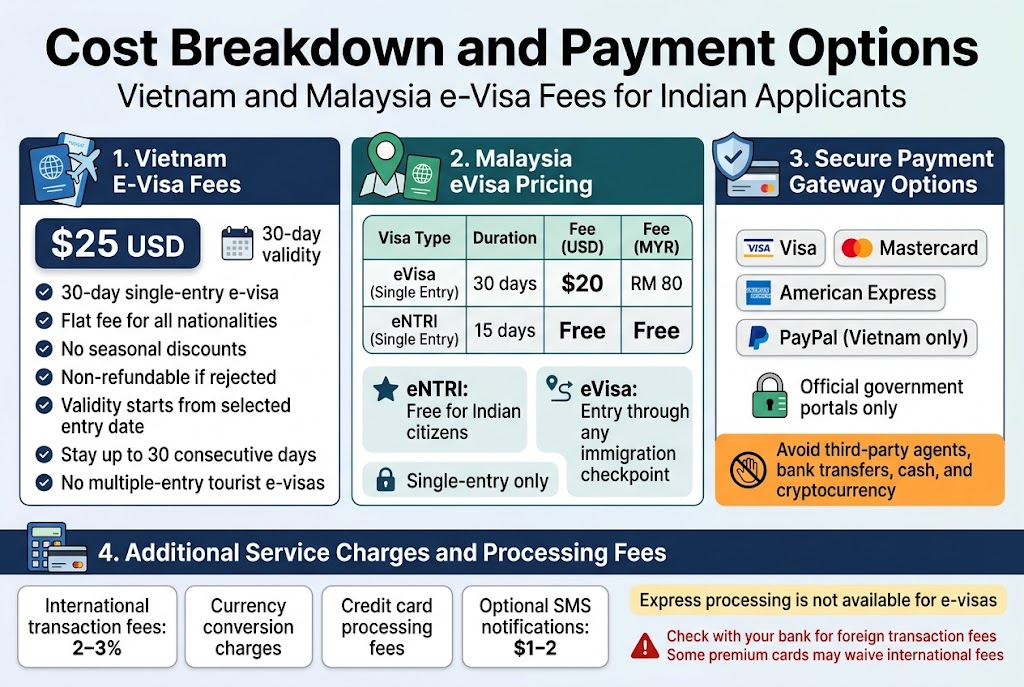
Vietnam E-Visa fees for Indian applicants
Vietnam charges a flat fee of $25 USD for their 30-day single-entry e-visa, regardless of your nationality. The pricing remains consistent year-round with no seasonal variations or special discounts for Indian citizens. This fee covers the official government processing and is non-refundable, even if your application gets rejected.
The 30-day validity period starts from your selected entry date, not the approval date. You can stay in Vietnam for up to 30 consecutive days with this visa. Currently, Vietnam doesn’t offer multiple-entry e-visas for tourists, so each trip requires a separate application and fee.
Malaysia eVisa pricing structure
Malaysia offers two main visa categories with different pricing tiers:
| Visa Type | Duration | Fee (USD) | Fee (MYR) |
|---|---|---|---|
| eVisa (Single Entry) | 30 days | $20 | RM 80 |
| eNTRI (Single Entry) | 15 days | Free | Free |
The eNTRI (Electronic Travel Registration & Information) remains completely free for Indian citizens, making Malaysia one of the most budget-friendly Southeast Asian destinations. However, eNTRI has stricter requirements – you must arrive and depart via specific airports and cannot extend your stay.
The standard eVisa costs $20 USD and allows entry through any immigration checkpoint in Malaysia. Both visas are single-entry only, meaning you cannot leave and re-enter Malaysia on the same visa.
Secure payment gateway options
Both countries accept major international payment methods through secure government portals:
Accepted Payment Methods:
- Visa credit/debit cards
- Mastercard credit/debit cards
- American Express (limited acceptance)
- PayPal (Vietnam only)
The Vietnam e-visa portal uses SSL encryption and redirects to verified payment processors. Malaysia’s eVisa system integrates directly with government-approved payment gateways that meet international security standards.
Avoid third-party payment platforms or agents who request bank transfers or unusual payment methods. Official government portals never ask for cash payments or cryptocurrency transactions.
Additional service charges and processing fees
Government fees represent the base cost, but several additional charges might apply:
Banking Charges:
- International transaction fees (2-3% of total amount)
- Currency conversion charges
- Credit card processing fees
Optional Service Fees:
- Express processing (not available for e-visas)
- SMS notifications ($1-2 USD)
- Email delivery confirmations
Most Indian banks charge foreign transaction fees ranging from 2-4% of the total amount. Check with your bank before applying to understand the complete cost breakdown. Some premium credit cards waive international transaction fees, potentially saving you money.
Never pay extra fees to third-party agencies claiming to “expedite” your application. Both Vietnam and Malaysia process e-visas through official government systems with fixed timelines that cannot be shortened through additional payments.
Processing Timeline and Approval Status Tracking
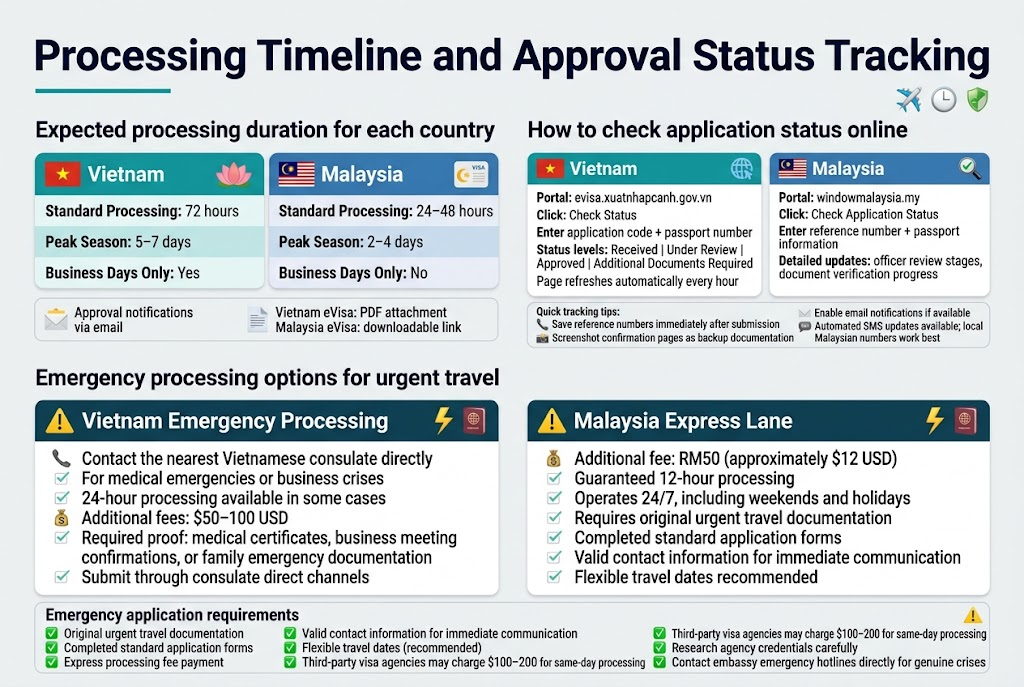
Expected processing duration for each country
Vietnam e-visas typically take 3-5 business days to process, though most applications receive approval within 72 hours. The Vietnamese immigration department processes applications Monday through Friday, excluding national holidays. Peak travel seasons like Tet holiday (January-February) and summer months may extend processing times slightly.
Malaysia eVisa processing runs faster, with most applications approved within 24-48 hours. The Malaysian government’s automated system works around the clock, making weekend submissions possible. During major festivals like Eid or Chinese New Year, expect delays of 1-2 additional days.
| Country | Standard Processing | Peak Season | Business Days Only |
|---|---|---|---|
| Vietnam | 72 hours | 5-7 days | Yes |
| Malaysia | 24-48 hours | 2-4 days | No |
Both countries send approval notifications via email, so check your spam folder regularly. Vietnamese e-visas arrive as PDF attachments, while Malaysian eVisas appear as downloadable links in the approval email.
How to check application status online
Vietnam provides a straightforward tracking system through their official immigration portal. Use your application reference number and passport details to log in. The system displays four status levels: “Received,” “Under Review,” “Approved,” or “Additional Documents Required.”
Access the Vietnam e-visa tracking portal at evisa.xuatnhapcanh.gov.vn and click “Check Status.” Enter your application code (received during submission) and passport number. The page refreshes automatically every hour with updates.
Malaysia’s tracking system works similarly through their eVisa portal. Navigate to windowmalaysia.my and select “Check Application Status.” Input your reference number and passport information. The Malaysian system provides more detailed updates, including officer review stages and document verification progress.
Quick tracking tips:
- Save your reference numbers immediately after submission
- Check status daily during business hours for fastest updates
- Screenshot confirmation pages as backup documentation
- Enable email notifications if the option exists
Both systems send automated SMS updates to registered mobile numbers, though this service works better for local Malaysian phone numbers than international ones.
Emergency processing options for urgent travel
Vietnam offers expedited processing for urgent travel situations, though options remain limited. Contact the nearest Vietnamese consulate directly for emergency cases like medical emergencies or business crises. Some consulates provide 24-hour processing for additional fees ranging from $50-100 USD.
The Vietnamese embassy’s emergency service requires documented proof of urgency – medical certificates, business meeting confirmations, or family emergency documentation. Submit these alongside your standard e-visa application through the consulate’s direct channels rather than the online portal.
Malaysia provides more flexible emergency options through their express lane service. Pay an additional RM50 (approximately $12 USD) for guaranteed 12-hour processing. This service operates 24/7, including weekends and holidays.
Emergency application requirements:
- Original urgent travel documentation
- Completed standard application forms
- Express processing fee payment
- Valid contact information for immediate communication
- Flexible travel dates (recommended)
Third-party visa agencies also offer emergency services, charging premium rates of $100-200 for guaranteed same-day processing. Research agency credentials carefully, as unofficial services may cause application rejections or delays.
Contact embassy emergency hotlines directly for genuine crises – Vietnam maintains 24/7 consular services in major cities, while Malaysia offers emergency assistance through their diplomatic missions worldwide.
Common Application Mistakes to Avoid
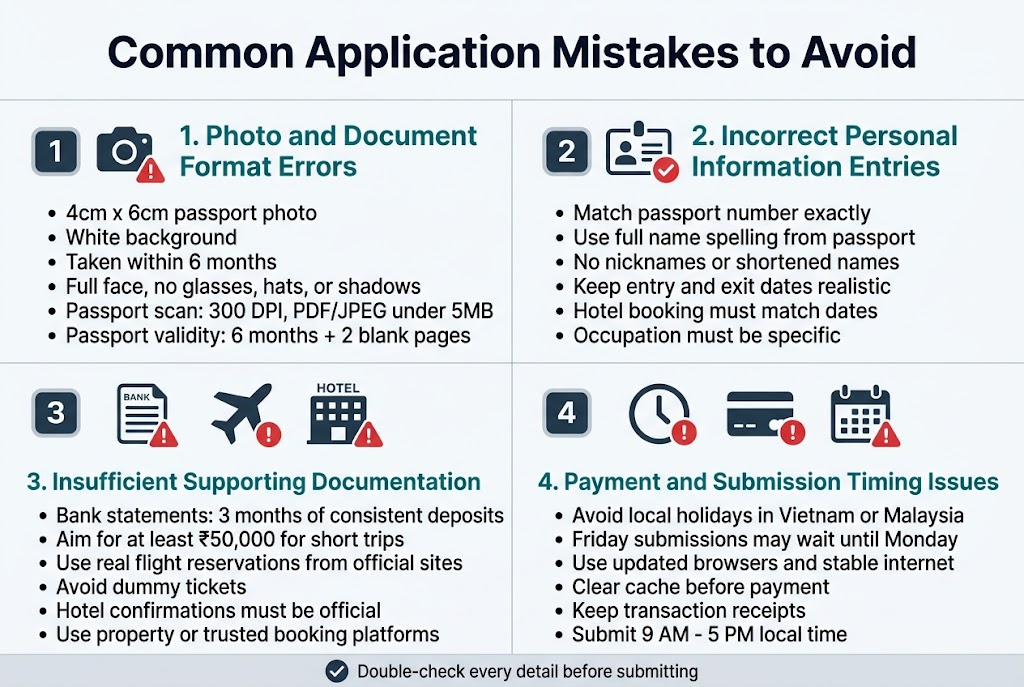
Photo and Document Format Errors
Photo specifications cause more visa rejections than any other single factor. Your passport-size photo must be exactly 4cm x 6cm with a white background, taken within the last six months. The photo needs to show your full face without glasses, hats, or shadows. Many applicants upload selfies or cropped photos from social media – these get rejected instantly.
Document format matters just as much. Scan your passport bio page at 300 DPI minimum, saving it as a PDF or high-quality JPEG under 5MB. Blurry phone photos won’t work. Your passport must have at least six months validity and two blank pages for entry stamps.
Incorrect Personal Information Entries
Even tiny typos derail your application. Double-check your passport number, full name spelling, and birthdate against your actual passport. Don’t use nicknames or shortened versions of your name – match exactly what’s printed in your passport.
Entry and exit dates trip up many travelers. Pick realistic travel dates and stick to them. Changing your itinerary after approval can cause problems at immigration. Your hotel booking confirmation must match these exact dates.
Occupation fields require careful attention. “Student” works better than “Unemployed” even if you’re between jobs. Business travelers should specify their exact role rather than generic terms like “Manager.”
Insufficient Supporting Documentation
Bank statements must show consistent deposits over three months, not sudden large transfers right before application. Your account balance should reflect genuine financial stability – aim for at least ₹50,000 for short trips.
Flight bookings don’t need to be paid tickets initially, but they must be realistic routes with actual airlines. Dummy tickets from sketchy websites often get flagged. Use official airline websites or trusted travel agents for reservation confirmations.
Hotel confirmations should come directly from the property or established booking platforms. Screenshots of hotel websites won’t suffice – you need official booking confirmations with your name and dates.
Payment and Submission Timing Issues
Never submit applications during local holidays in Vietnam or Malaysia. Processing stops completely, adding unexpected delays to your timeline. Friday submissions often get processed the following Monday, so plan accordingly.
Payment failures happen when using older browser versions or unstable internet connections. Clear your cache, use updated browsers, and ensure stable connectivity before starting payment. Keep transaction receipts – you’ll need them if payment issues arise.
Submission timing affects processing speed. Apply between 9 AM – 5 PM local time in the destination country for fastest review. Weekend applications sit in queues until Monday morning.
Post-Approval Steps and Travel Preparation
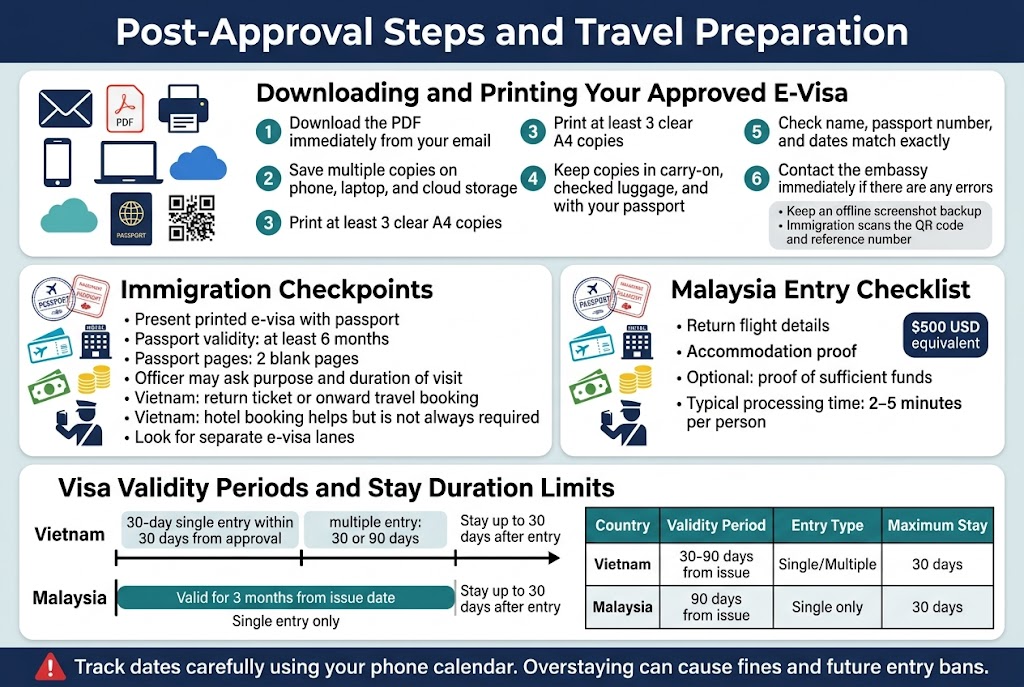
Downloading and Printing Your Approved E-Visa
Your approved e-visa will arrive in your email inbox as a PDF attachment. Download this document immediately and save multiple copies on different devices – your phone, laptop, and cloud storage. The PDF contains a unique QR code and reference number that immigration officers will scan upon arrival.
Print at least three physical copies on standard A4 paper using a high-quality printer. Blurry or faded printouts can cause delays at immigration checkpoints. Keep one copy in your carry-on bag, another in your checked luggage, and a third copy with your passport. Many travelers also take screenshots of their e-visa and store them offline on their phones as backup.
Check every detail on your approved e-visa matches your passport exactly – name spelling, passport number, and dates. If you spot any errors, contact the embassy immediately before traveling. Don’t risk showing up with incorrect information.
Entry Requirements at Immigration Checkpoints
Present your printed e-visa along with your passport to the immigration officer. Your passport must have at least six months of validity remaining and two blank pages for entry stamps. The officer will verify your e-visa details against their system and may ask basic questions about your visit purpose and duration.
For Vietnam, you’ll also need proof of onward travel – either a return ticket or booking confirmation for your next destination. Hotels bookings aren’t always required but having them ready speeds up the process. Some immigration counters use separate lanes for e-visa holders, so look for designated signs.
In Malaysia, immigration officers expect to see your return flight details and accommodation proof. They rarely ask for bank statements, but having proof of sufficient funds (around $500 USD equivalent) can help if questioned. The entire process typically takes 2-5 minutes per person.
Visa Validity Periods and Stay Duration Limits
Vietnam e-visas allow single or multiple entries depending on your application type. Single-entry visas permit one entry within 30 days from your approval date, while multiple-entry options give you 30 or 90 days. Once you enter Vietnam, you can stay for up to 30 days regardless of your visa validity period.
Malaysia eVisas are valid for three months from the issue date and allow single entry only. You can stay for up to 30 days once you enter the country. Your entry must occur before the visa expires – arriving on the last day of validity is perfectly acceptable.
| Country | Validity Period | Entry Type | Maximum Stay |
|---|---|---|---|
| Vietnam | 30-90 days from issue | Single/Multiple | 30 days |
| Malaysia | 90 days from issue | Single only | 30 days |
Track these dates carefully using your phone calendar. Overstaying results in hefty fines and potential entry bans for future visits.
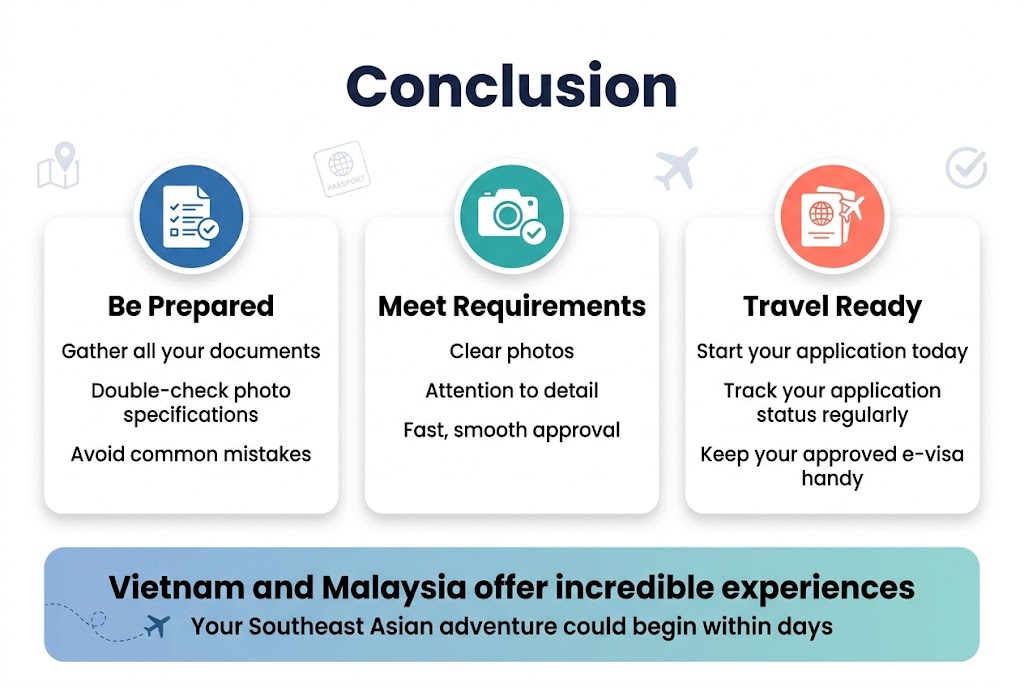
Getting your e-visa for Vietnam or Malaysia doesn’t have to be a stressful experience. With the right documents ready, clear photos that meet requirements, and attention to detail during the application process, you can have your visa approved quickly and smoothly. The key is being prepared before you start – gather all your documents, double-check photo specifications, and avoid the common mistakes that can delay your approval.
Start your application today and you could be planning your Southeast Asian adventure within days. Remember to track your application status regularly and keep your approved e-visa handy when you travel. Both Vietnam and Malaysia offer incredible experiences, and now you have the roadmap to get there without any visa hassles holding you back.


