

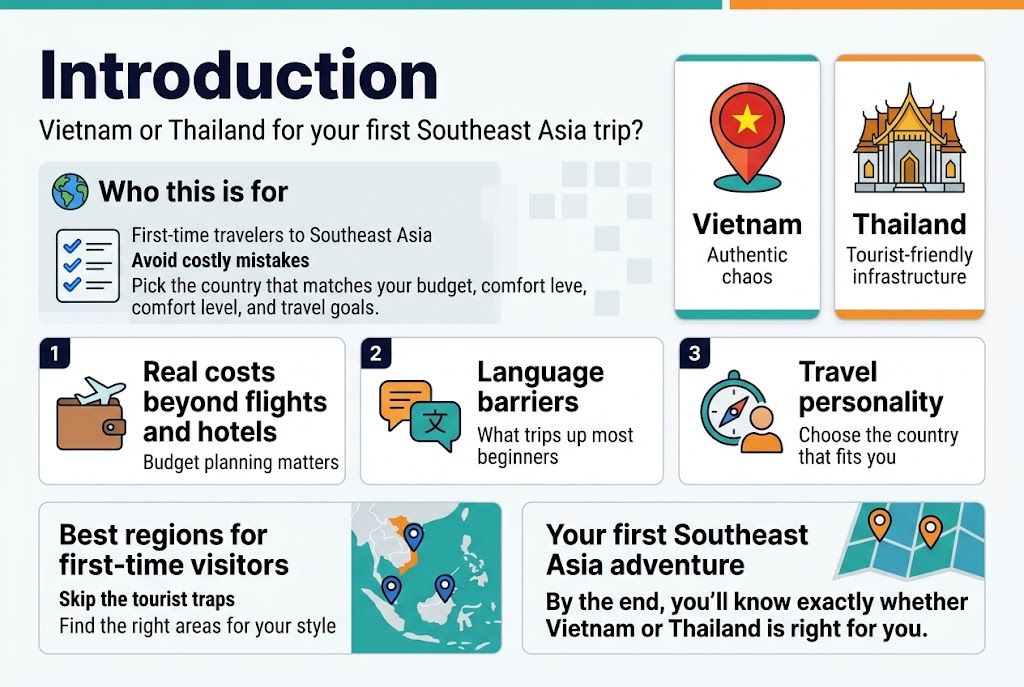
Most first-time visitors to Southeast Asia end up disappointed because they pick Vietnam or Thailand based on Instagram photos instead of their actual travel style. This guide helps new travelers make the right choice between these two incredible destinations.
Who this is for: First-time travelers to Southeast Asia who want to avoid costly mistakes and pick the country that matches their budget, comfort level, and travel goals.
We’ll break down the real costs beyond flights and hotels, show you how to handle language barriers that trip up most beginners, and help you figure out which country fits your travel personality. You’ll also learn which specific regions work best for different types of first-time visitors, so you can skip the tourist traps and have an amazing trip.
By the end, you’ll know exactly whether Vietnam’s authentic chaos or Thailand’s tourist-friendly infrastructure is right for your first Southeast Asian adventure.
Understanding Your First-Timer Priorities and Travel Goals
Defining your comfort level with cultural differences
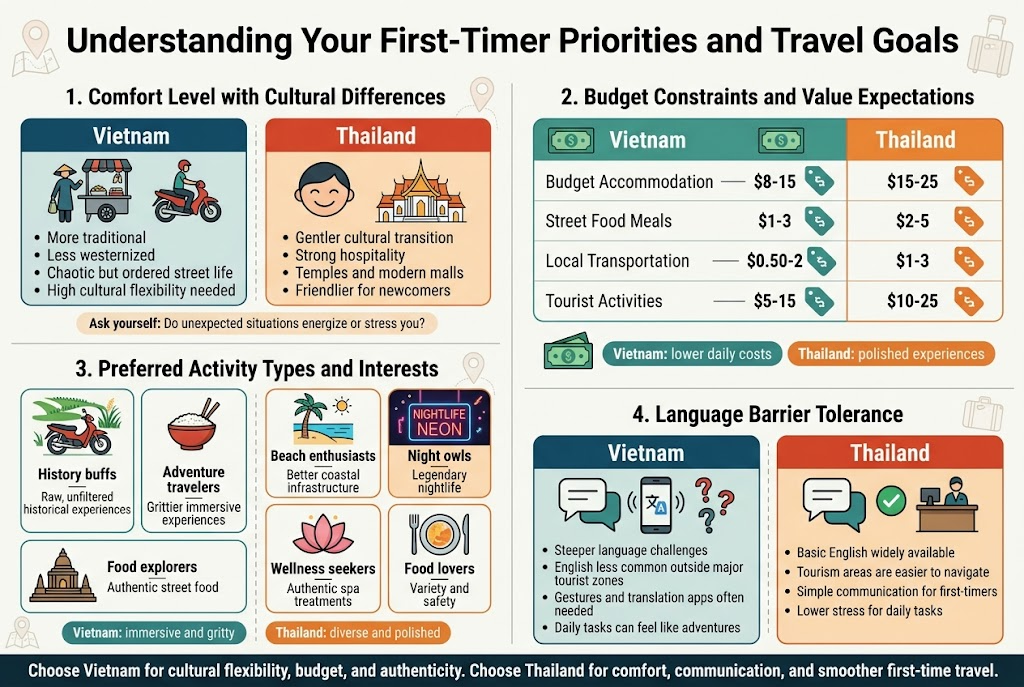
Vietnam and Thailand present wildly different cultural experiences that can either thrill or overwhelm first-time visitors. Vietnam maintains a more traditional, less westernized atmosphere where ancient customs blend with communist influences. You’ll encounter street vendors cooking on sidewalks, motorbike traffic that seems chaotic but follows unspoken rules, and social interactions that prioritize respect and hierarchy.
Thailand, especially in tourist areas, offers a gentler cultural transition. The “Land of Smiles” reputation isn’t just marketing – Thai people genuinely embrace hospitality as a cultural cornerstone. Buddhist temples coexist peacefully with modern shopping malls, and the tourism infrastructure makes cultural navigation smoother for newcomers.
Ask yourself honestly: Do unexpected situations energize or stress you? Can you handle staring because you’re foreign? Vietnam demands more cultural flexibility, while Thailand provides cultural immersion with training wheels.
Assessing your budget constraints and value expectations
Money conversations matter before you board that plane. Vietnam consistently ranks as the more budget-friendly option, with daily expenses running 30-40% lower than Thailand. A decent hostel bed in Ho Chi Minh City costs $8-12, while Bangkok equivalents start around $15-20.
| Expense Category | Vietnam (Daily) | Thailand (Daily) |
|---|---|---|
| Budget Accommodation | $8-15 | $15-25 |
| Street Food Meals | $1-3 | $2-5 |
| Local Transportation | $0.50-2 | $1-3 |
| Tourist Activities | $5-15 | $10-25 |
Your money stretches further in Vietnam, but Thailand delivers more polished experiences. Vietnamese street food costs pennies but might challenge sensitive stomachs. Thai massage parlors offer professional services, while Vietnamese equivalents vary dramatically in quality and hygiene standards.
Budget travelers often choose Vietnam for pure affordability. Comfort-seekers who want reliable experiences lean toward Thailand despite higher costs.
Determining your preferred activity types and interests
Adventure seekers and culture enthusiasts face different opportunities in each country. Vietnam excels at immersive experiences – cooking classes with local families, motorbike tours through rice paddies, and historical sites that tell powerful stories. The Cu Chi Tunnels near Ho Chi Minh City and Ha Long Bay offer unique experiences you can’t replicate elsewhere.
Thailand caters to diverse interests more easily. Beach lovers find world-class islands, party enthusiasts discover legendary nightlife, wellness seekers access authentic spa treatments, and food lovers enjoy refined street food scenes. Thai tourism infrastructure supports multiple activity types within single destinations.
Consider your primary interests:
- History buffs: Vietnam offers raw, unfiltered historical experiences
- Beach enthusiasts: Thailand provides better developed coastal infrastructure
- Adventure travelers: Both excel, but Vietnam offers grittier experiences
- Food explorers: Vietnam wins on authenticity, Thailand on variety and safety
- Night owls: Thailand dominates nightlife scenes
Evaluating your tolerance for language barriers
English proficiency creates starkly different experiences between these countries. Thailand’s tourism-dependent economy has produced widespread basic English skills, especially in tourist areas. Hotel staff, restaurant workers, and tour guides typically communicate effectively in English.
Vietnam presents steeper language challenges. Outside major tourist zones, English speakers become scarce. Even in popular areas like Hanoi’s Old Quarter, communication often relies on gestures, translation apps, and patience. Vietnamese pronunciation differs significantly from English, making even basic phrases challenging for beginners.
Your language barrier tolerance directly impacts daily experiences. Simple tasks like ordering food, asking directions, or resolving problems become adventures in Vietnam. Thailand allows more straightforward communication, reducing stress for first-time Asian travelers.
Smartphone translation apps help, but real-time conversations still require confidence and creativity. If language barriers excite you as cultural challenges, Vietnam rewards that attitude. If communication difficulties cause anxiety, Thailand’s English-friendly environment provides reassurance.
Solving Budget Concerns: Cost Comparison and Money-Saving Tips
Accommodation costs and quality differences between countries
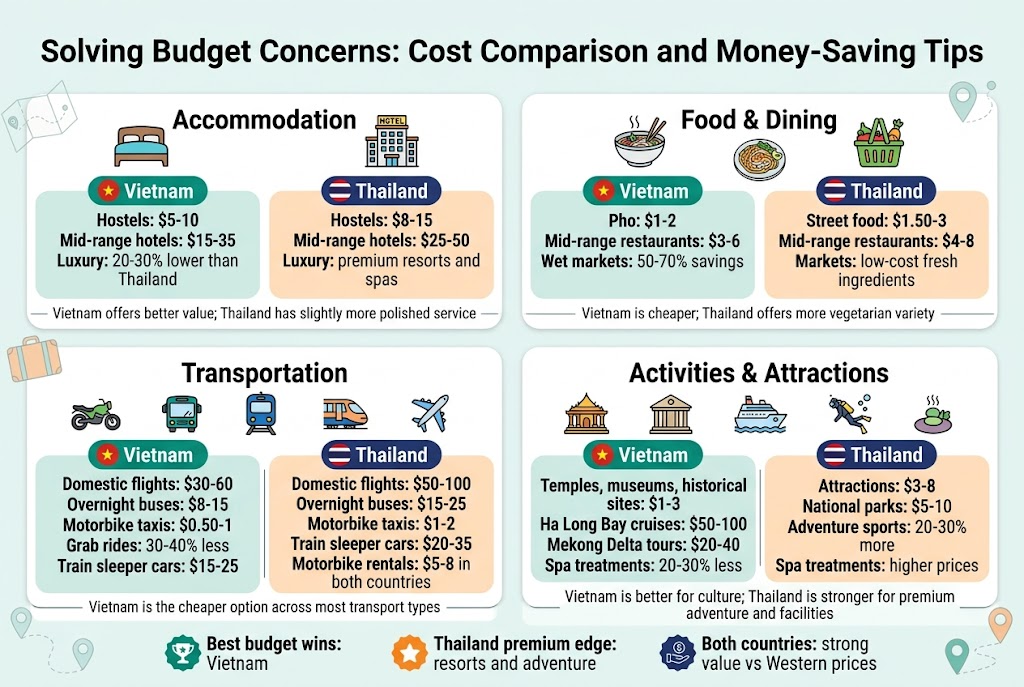
Both Vietnam and Thailand offer excellent value for accommodation, but the pricing structures and quality standards differ significantly between the two destinations. In Thailand, budget hostels typically range from $8-15 per night, while mid-range hotels cost $25-50. Vietnam consistently beats these prices, with hostels starting at $5-10 and comparable mid-range options available for $15-35 per night.
The quality gap has narrowed considerably in recent years. Vietnam’s hospitality industry has rapidly improved, with many properties rivaling Thai standards. Thai accommodations generally offer more polished service and amenities, but Vietnamese hotels often provide better value for money with larger rooms and more included services.
For luxury travelers, Thailand maintains a slight edge with world-renowned resorts and spas, but Vietnam’s luxury scene has exploded with stunning boutique properties at 20-30% lower prices than comparable Thai establishments.
Food expenses and dining value propositions
Street food represents the biggest budget win in both countries, but Vietnam takes the crown for pure affordability. A hearty bowl of pho costs $1-2, while Thai street dishes like pad thai typically run $1.50-3. Restaurant meals show a similar pattern – Vietnamese mid-range restaurants charge $3-6 per dish compared to Thailand’s $4-8.
The dining experience differs dramatically. Thai cuisine offers more variety for vegetarians and those with dietary restrictions, while Vietnamese food heavily features fresh herbs, lighter broths, and grilled meats. Both countries provide exceptional value compared to Western dining costs.
Local markets offer the best savings in both destinations. Shopping at Vietnamese wet markets can reduce food costs by 50-70% compared to restaurants, while Thai markets provide fresh ingredients at similarly low prices.
Transportation costs for getting around and between cities
Vietnam’s transportation network proves more budget-friendly across all categories. Domestic flights between major Vietnamese cities cost $30-60, while Thai domestic routes typically run $50-100. Overnight buses in Vietnam cost $8-15 for long journeys, compared to Thailand’s $15-25 for similar distances.
Local transportation favors Vietnam significantly. Motorbike taxis cost $0.50-1 in Vietnamese cities versus $1-2 in Thailand. Grab rides in Vietnam average 30-40% less than equivalent Thai trips. Train travel in Vietnam offers better value with sleeper cars costing $15-25 for overnight journeys, while Thai trains charge $20-35 for comparable routes.
Motorbike rentals represent one area where costs align closely – both countries charge $5-8 daily for scooters, though Vietnamese rental shops often include free helmets and basic insurance.
Activity and attraction pricing structures
Vietnam delivers superior value for cultural and historical attractions. Most Vietnamese temples, museums, and historical sites charge $1-3 entry fees, while Thai attractions typically cost $3-8. Notable exceptions include premium experiences like Ha Long Bay cruises ($50-100) and Mekong Delta tours ($20-40).
Thailand excels in adventure activities and water sports. Scuba diving, rock climbing, and zip-lining often cost 20-30% more in Thailand, but the infrastructure and safety standards justify the premium. Thai national parks charge higher entrance fees ($5-10 versus Vietnam’s $2-5), but offer superior facilities and English-language information.
Spa treatments and massages provide excellent value in both countries, with Vietnamese services typically costing 20-30% less than Thai equivalents while maintaining similar quality standards.
Overcoming Language and Communication Barriers
English proficiency levels in tourist areas
Thailand clearly takes the lead when it comes to English communication in tourist hotspots. Bangkok, Phuket, Chiang Mai, and Koh Samui have decades of tourism development behind them, creating a workforce that’s comfortable with basic English interactions. Hotel staff, restaurant workers, and tour guides typically speak enough English to handle standard requests and provide directions.
Vietnam’s English proficiency varies dramatically by location and generation. Ho Chi Minh City and Hanoi offer better English support than Thailand’s secondary cities, but the gap widens significantly in places like Hoi An or Da Lat. Younger Vietnamese people often speak impressive English, while older generations rely more heavily on gestures and basic phrases.
| Location | Thailand English Level | Vietnam English Level |
|---|---|---|
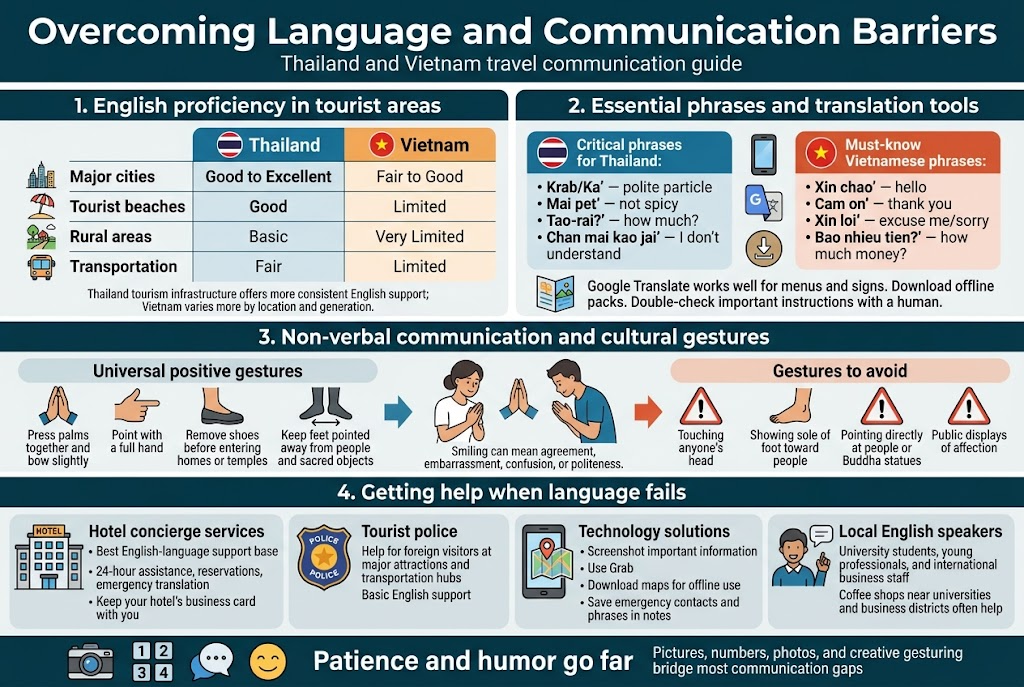
| Major cities | Good to Excellent | Fair to Good |
| Tourist beaches | Good | Limited |
| Rural areas | Basic | Very Limited |
| Transportation | Fair | Limited |
The difference becomes most apparent when you venture beyond the main tourist trail. Thailand’s tourism infrastructure has trained locals to anticipate foreign visitor needs, while Vietnam’s rapid tourism growth means many areas are still catching up with English-language support.
Essential phrases and translation app effectiveness
Smart travelers pack both digital tools and backup communication strategies. Google Translate works remarkably well for both countries, but Vietnam’s tonal language creates more room for misunderstanding through voice translation features.
Critical phrases for Thailand:
- “Krab/Ka” (polite particle – use constantly)
- “Mai pet” (not spicy)
- “Tao-rai?” (how much?)
- “Chan mai kao jai” (I don’t understand)
Must-know Vietnamese phrases:
- “Xin chao” (hello)
- “Cam on” (thank you)
- “Xin loi” (excuse me/sorry)
- “Bao nhieu tien?” (how much money?)
Translation apps shine for reading menus and signs, but struggle with context and cultural nuance. Download offline language packs before traveling – wifi isn’t guaranteed everywhere. Point It books, featuring pictures of common items and situations, serve as excellent backups when technology fails.
The camera translation feature in Google Translate transforms Vietnamese and Thai text instantly, making restaurant menus and street signs accessible. However, always double-check important information like transportation schedules or medical instructions with a human when possible.
Non-verbal communication and cultural gestures
Body language speaks volumes in Southeast Asia, and getting it wrong can create awkward situations or unintended offense. Both countries share some Buddhist-influenced customs, but each has distinct cultural codes.
Universal positive gestures:
- Slight bow with hands pressed together (wai in Thailand, similar respect gesture in Vietnam)
- Pointing with full hand instead of index finger
- Removing shoes before entering homes or temples
- Keeping feet pointed away from people and sacred objects
Gestures to avoid:
- Touching anyone’s head (considered sacred)
- Showing sole of foot toward people
- Pointing directly at people or Buddha statues
- Public displays of affection (especially in rural areas)
Thai people use the “wai” greeting extensively – press palms together at chest level and bow slightly. The higher the hands, the more respect shown. Vietnamese greetings tend to be more informal handshakes, especially in cities, though rural areas appreciate the traditional bow.
Smiling works everywhere, but understand that Southeast Asian smiles can mean different things – agreement, embarrassment, confusion, or politeness. Don’t assume a smile always means “yes” or understanding.
Getting help when language fails
Every traveler faces moments when communication breaks down completely. Having multiple backup strategies prevents minor misunderstandings from becoming major problems.
Hotel concierge services provide your best English-language support base. Many hotels offer 24-hour assistance and can help with everything from restaurant reservations to emergency translation. Keep your hotel’s business card with you – taxi drivers can always get you back to familiar territory.
Tourist police in both countries specifically train to help foreign visitors. They’re stationed at major attractions and transportation hubs, marked with special uniforms or signs. Tourist police officers typically speak basic English and can assist with serious communication needs.
Technology solutions extend beyond translation apps:
- Screenshot important information like addresses or instructions
- Use ride-sharing apps like Grab (available in both countries) to avoid language barriers with taxi drivers
- Download maps for offline use
- Keep emergency contacts and phrases saved in your phone’s notes
Local English speakers often appear in unexpected places. University students, young professionals, and people working in international businesses frequently offer help when they see travelers struggling. Coffee shops near universities or modern business districts typically have English-speaking staff.
Drawing pictures, using numbers, and showing photos on your phone bridges most communication gaps. Patience and humor go far – locals appreciate travelers who make an effort, even when that effort involves enthusiastic gesturing and creative improvisation.
Navigating Cultural Differences and Social Customs
Dress codes and appropriate behavior expectations
Thailand leans toward conservative dress standards, especially in temples and formal settings. You’ll need to cover shoulders, knees, and cleavage when visiting religious sites. Tank tops and shorts won’t cut it at the Grand Palace in Bangkok. Pack lightweight long pants and shirts with sleeves – the fabric doesn’t need to be heavy since both countries are hot.
Vietnam takes a more relaxed approach to casual dress, but still expects modesty in sacred spaces. Street food vendors won’t judge your flip-flops and shorts, but pagodas require covered shoulders and legs just like Thai temples.
Public displays of affection differ between the countries. Thai couples rarely hold hands or kiss in public, viewing such behavior as inappropriate. Vietnamese attitudes vary by generation – younger people in cities like Ho Chi Minh are more open, while rural areas remain traditional.
Both cultures value quiet, respectful behavior. Loud conversations, pointing with your index finger, or touching someone’s head are considered rude. Use your whole hand to gesture, and keep voices down in restaurants and public transport.
Tipping customs and service interaction styles
Tipping practices create confusion for first-timers. Thailand doesn’t expect tips in most situations – rounding up taxi fares or leaving small change at restaurants is appreciated but not required. Luxury hotels and high-end restaurants may include service charges, making additional tips unnecessary.
Vietnam’s tipping culture is even more minimal. Street food vendors and local restaurants don’t expect tips at all. Tourist-focused establishments might appreciate small amounts, but locals rarely tip service staff.
Service styles differ dramatically between countries. Thai service emphasizes smiling politeness and avoiding confrontation. Staff rarely say “no” directly, instead using phrases like “maybe difficult” or “we will try.” This indirect communication style prevents loss of face for everyone involved.
Vietnamese service tends toward efficiency rather than excessive friendliness. Don’t interpret directness as rudeness – it’s simply cultural difference. Bargaining is expected in Vietnamese markets, while Thai vendors often post fixed prices.
Religious site etiquette and cultural sensitivities
Buddhist temples dominate both countries but have distinct rules. Remove shoes before entering any temple building – look for shoe racks outside doors. Never point your feet toward Buddha statues or monks, and avoid sitting with legs stretched out.
Thai temple etiquette includes specific protocols for women. Female visitors cannot touch or hand items directly to monks. If you need to give something to a monk, place it on a cloth or ask a man to transfer it. Sit with feet tucked behind you, never pointing toward the altar.
Vietnamese pagodas blend Buddhist, Confucian, and local spiritual traditions. Photography rules vary by location – some allow pictures while others prohibit cameras entirely. Ask permission before taking photos, especially of people praying.
Both cultures consider the head sacred and feet dirty. Never touch someone’s head, even children, and don’t use your feet to point at people or religious objects. When sitting on floors in temples, tuck your feet to the side or behind you.
Monks deserve special respect in both countries. Stand when they pass, give them space on public transport, and speak quietly around temples. Early morning alms giving in Thailand requires respectful observation from a distance unless you’re participating properly.
| Country | Temple Dress Code | Photography | Shoe Removal | Monk Interaction |
|---|---|---|---|---|
| Thailand | Covered shoulders/knees required | Usually allowed in courtyards | Always before buildings | Women cannot touch |
| Vietnam | Modest clothing expected | Ask permission first | Required for prayer halls | General respect needed |
Resolving Safety and Health Concerns for Beginners
Crime rates and tourist-targeted scams to avoid
Both Vietnam and Thailand have relatively low violent crime rates, but petty theft and tourist-targeted scams are common. In Thailand, watch out for gem scams in Bangkok, fake police checkpoints, and overcharging at restaurants and shops. Tuk-tuk drivers often take you to overpriced tailors or jewelry stores where they earn commissions.
Vietnam’s most common scams include fake tour companies, motorcycle taxi overcharging, and the classic “tea ceremony” scam where friendly locals invite you for tea that costs hundreds of dollars. In Ho Chi Minh City, bag snatching from motorcycles happens frequently, especially near tourist areas.
| Safety Concern | Vietnam | Thailand |
|---|---|---|
| Petty Theft | Moderate risk in cities | Low to moderate risk |
| Tourist Scams | High in tourist areas | Moderate, well-documented |
| Violent Crime | Very low | Very low |
| Police Corruption | Occasional issues | Rare encounters |
Food safety and stomach adjustment strategies
Street food poses the biggest health challenge for first-timers in both countries. Thailand generally has higher food safety standards, but both destinations can cause digestive issues if you’re not careful.
Start slowly with local cuisine and choose busy food stalls with high turnover. Avoid ice cubes, raw vegetables, and unpasteurized dairy products during your first few days. Bottled water is essential in both countries, though Thailand’s tap water is safer in major cities.
Pack probiotics before your trip and bring anti-diarrheal medication. Oral rehydration salts are lifesavers if you get sick. Thai food tends to be spicier and can be harder on sensitive stomachs, while Vietnamese cuisine is generally milder but uses more raw herbs and vegetables.
Healthcare access and medical emergency preparation
Thailand offers superior healthcare infrastructure with internationally accredited hospitals in Bangkok, Phuket, and Chiang Mai. Many doctors speak English, and medical costs are reasonable. Bangkok Hospital and Bumrungrad International Hospital provide world-class care.
Vietnam’s healthcare system varies dramatically by location. Ho Chi Minh City and Hanoi have decent private hospitals, but rural areas lack quality medical facilities. Language barriers are more significant in Vietnamese hospitals.
Travel insurance is non-negotiable for both countries. Ensure your policy covers motorcycle accidents since many tourists rent scooters. Medical evacuation coverage becomes crucial if you plan to visit remote areas in northern Vietnam or southern Thai islands.
Transportation safety and reliable travel options
Thailand’s transportation network is more developed and safer overall. BTS Skytrain in Bangkok, domestic flights, and VIP buses maintain high safety standards. Songthaews and tuk-tuks are generally safe but negotiate prices beforehand.
Vietnam’s transportation can be chaotic. Traffic in Ho Chi Minh City and Hanoi requires extreme caution when crossing streets. Sleeper buses vary in quality, and train services, while charming, can be slow and uncomfortable on longer routes.
Grab operates in both countries and provides the safest option for rides. Avoid riding motorcycles unless you’re experienced – accident rates are high in both destinations. For long distances, domestic flights offer the best safety-to-time ratio in both countries.


