

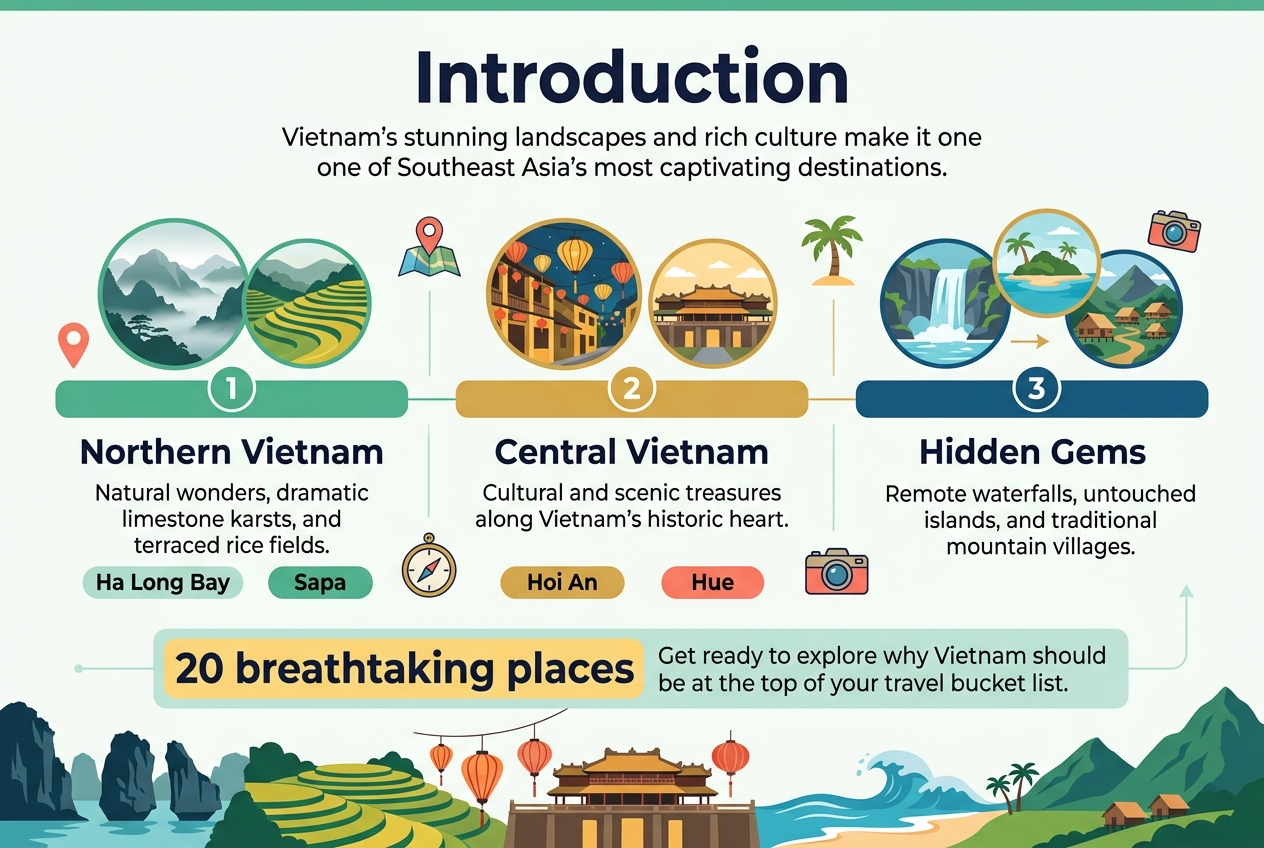
Vietnam’s stunning landscapes and rich culture make it one of Southeast Asia’s most captivating destinations. This Vietnam travel guide is perfect for adventure seekers, cultural enthusiasts, and nature lovers planning their first trip or returning for new experiences.
From misty mountains in the north to pristine beaches in the south, Vietnam’s top destinations offer something extraordinary at every turn. We’ll explore Northern Vietnam’s natural wonders like the dramatic limestone karsts of Ha Long Bay and the terraced rice fields of Sapa. You’ll also discover Central Vietnam’s cultural and scenic treasures, including the ancient town of Hoi An and the imperial city of Hue.
Finally, we’ll uncover Vietnam’s hidden gems that most tourists miss – remote waterfalls, untouched islands, and mountain villages where traditional life continues unchanged. Get ready to explore 20 breathtaking places that showcase why Vietnam should be at the top of your travel bucket list.
Northern Vietnam’s Natural Wonders
Ha Long Bay’s Emerald Waters and Limestone Karsts
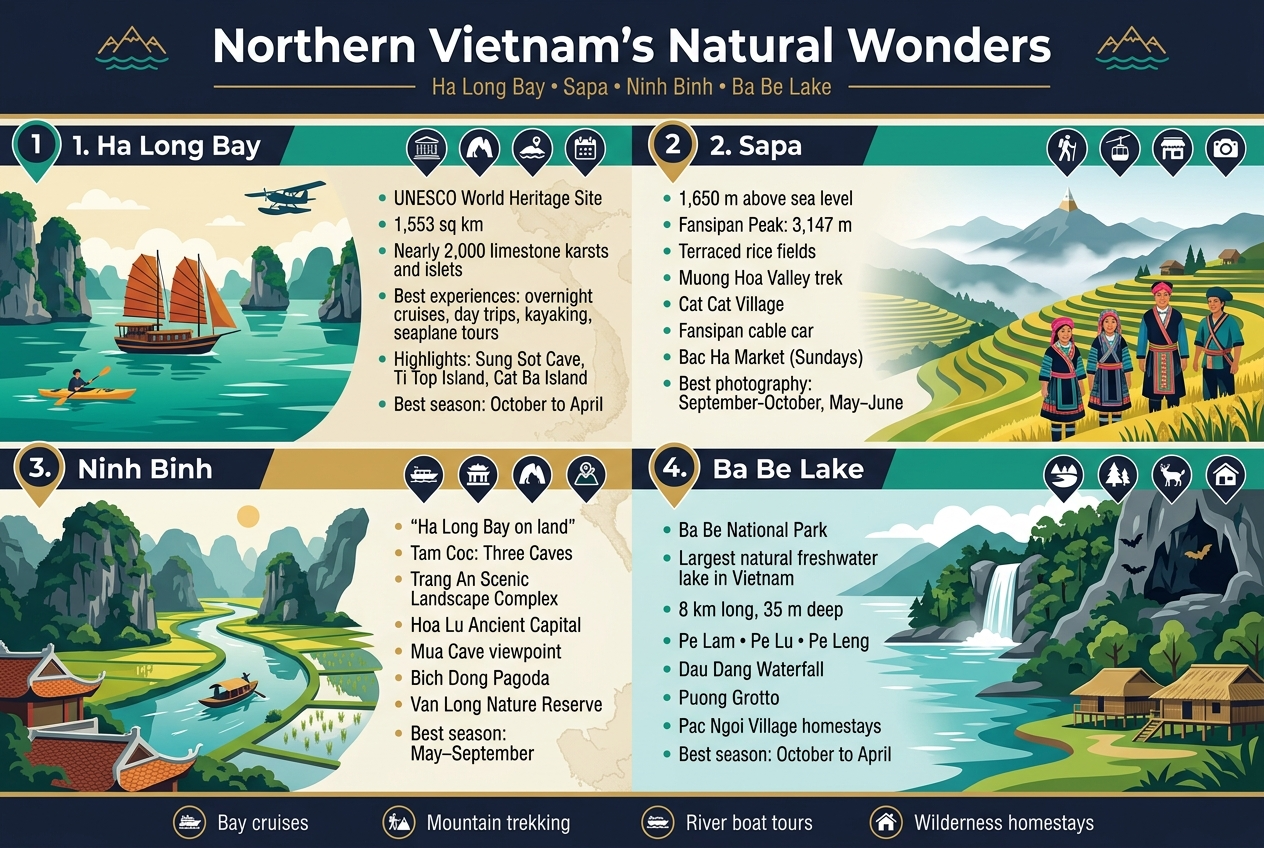
Vietnam travel destinations don’t get more iconic than Ha Long Bay, where thousands of limestone towers rise dramatically from emerald-green waters. This UNESCO World Heritage Site stretches across 1,553 square kilometers and features nearly 2,000 limestone karsts and islets. The bay’s name translates to “where the dragon descends into the sea,” and the mystical landscape truly feels otherworldly.
Best Ways to Experience Ha Long Bay:
- Overnight cruises – Traditional junks and luxury vessels offer 1-3 day adventures
- Day trips – Perfect for travelers short on time, departing from Hanoi
- Kayaking expeditions – Paddle through hidden lagoons and sea caves
- Seaplane tours – Aerial views reveal the bay’s full magnificence
The most popular activities include exploring Sung Sot Cave (Surprise Cave), one of the largest and most spectacular grottoes, and visiting Ti Top Island for panoramic views. Cat Ba Island serves as an excellent base for extended stays, offering hiking trails through Cat Ba National Park.
Peak Season: October to April brings clear skies and calm waters, while summer months can be hot and humid with occasional typhoons.
Sapa’s Terraced Rice Fields and Mountain Villages
Perched at 1,650 meters above sea level, Sapa ranks among Vietnam’s most breathtaking places to visit with its cascading rice terraces and vibrant hill tribe culture. The town sits in the Hoang Lien Son mountain range, where Fansipan Peak – Vietnam’s highest mountain at 3,147 meters – dominates the skyline.
The region’s terraced landscapes transform dramatically with the seasons. Spring brings water-filled terraces that mirror the sky, while autumn showcases golden rice ready for harvest. These agricultural masterpieces, carved into mountainsides over centuries by the Hmong, Dao, and other ethnic minorities, create some of Asia’s most photographed scenery.
Essential Sapa Experiences:
| Activity | Duration | Difficulty |
|---|---|---|
| Muong Hoa Valley trek | Half-day | Easy |
| Cat Cat Village visit | 2-3 hours | Easy |
| Fansipan cable car | Full day | Moderate |
| Multi-day homestay | 2-3 days | Varies |
The weekly Bac Ha Market (Sundays) offers authentic cultural immersion, where colorful hill tribes gather to trade goods and socialize. For the best photography, visit during September-October when rice terraces glow golden, or May-June when they’re emerald green.
Ninh Binh’s Ancient Temples and River Caves
Often called “Ha Long Bay on land,” Ninh Binh province showcases Vietnam’s natural wonders through a stunning landscape of limestone karsts, winding rivers, and ancient temples. This UNESCO World Heritage area combines geological marvels with rich historical significance, making it one of Vietnam’s top destinations for cultural and scenic experiences.
Tam Coc (“Three Caves”) offers the quintessential Ninh Binh experience. Traditional sampan boats navigate the Ngo Dong River through three magnificent limestone caves – Hang Ca, Hang Hai, and Hang Ba. Local rowers, often elderly women, skillfully pilot boats using their feet while pointing out hidden grottos and towering cliffs.
Must-Visit Attractions in Ninh Binh:
- Trang An Scenic Landscape Complex – Boat tours through 31 valleys and caves
- Hoa Lu Ancient Capital – Ruins of Vietnam’s 10th-11th century imperial city
- Mua Cave viewpoint – 500-step climb rewarded with panoramic valley views
- Bich Dong Pagoda – Ancient temple complex built into limestone cliffs
The region’s Van Long Nature Reserve provides excellent wildlife spotting opportunities, particularly for the endangered Delacour’s langur. Rice paddies stretch endlessly between karst formations, creating mirror-like reflections during the wet season (May-September).
Ba Be Lake’s Pristine Wilderness Experience
Hidden in northern Vietnam’s mountains, Ba Be National Park protects the country’s largest natural freshwater lake and offers an unspoiled wilderness experience far from tourist crowds. This pristine destination showcases Vietnam’s natural wonders through dense tropical forests, cascading waterfalls, and traditional Tay minority villages.
Ba Be Lake stretches 8 kilometers long and reaches depths of 35 meters, formed by tectonic activity millions of years ago. The lake’s three interconnected sections – Pe Lam, Pe Lu, and Pe Leng – create diverse ecosystems supporting over 400 plant species and numerous endemic fish varieties.
Adventure Activities at Ba Be:
- Multi-day boat expeditions exploring remote lake sections
- Trekking through primary forest to Dau Dang Waterfall
- Cave exploration at Puong Grotto with thousands of bats
- Homestays with Tay families in traditional stilt houses
- Bird watching – over 200 species recorded in the park
The park’s isolation means fewer facilities but authentic experiences. Pac Ngoi Village offers the most comfortable homestay options, where families serve fresh lake fish and organic vegetables. The best visiting period runs from October to April when weather conditions allow comfortable trekking and clear lake views.
Getting to Ba Be requires a 5-6 hour journey from Hanoi, but the untouched natural beauty and cultural immersion make it worthwhile for adventurous travelers seeking Vietnam’s hidden gems away from typical tourist attractions.
Central Vietnam’s Cultural and Scenic Treasures
Hoi An’s Lantern-Lit Ancient Streets
Walking through Hoi An feels like stepping back in time to a world where silk merchants and spice traders ruled the Mekong Delta. This UNESCO World Heritage site stands as one of Vietnam’s most enchanting Vietnam tourist attractions, where golden-hued colonial buildings line narrow cobblestone streets that have remained virtually unchanged for centuries.
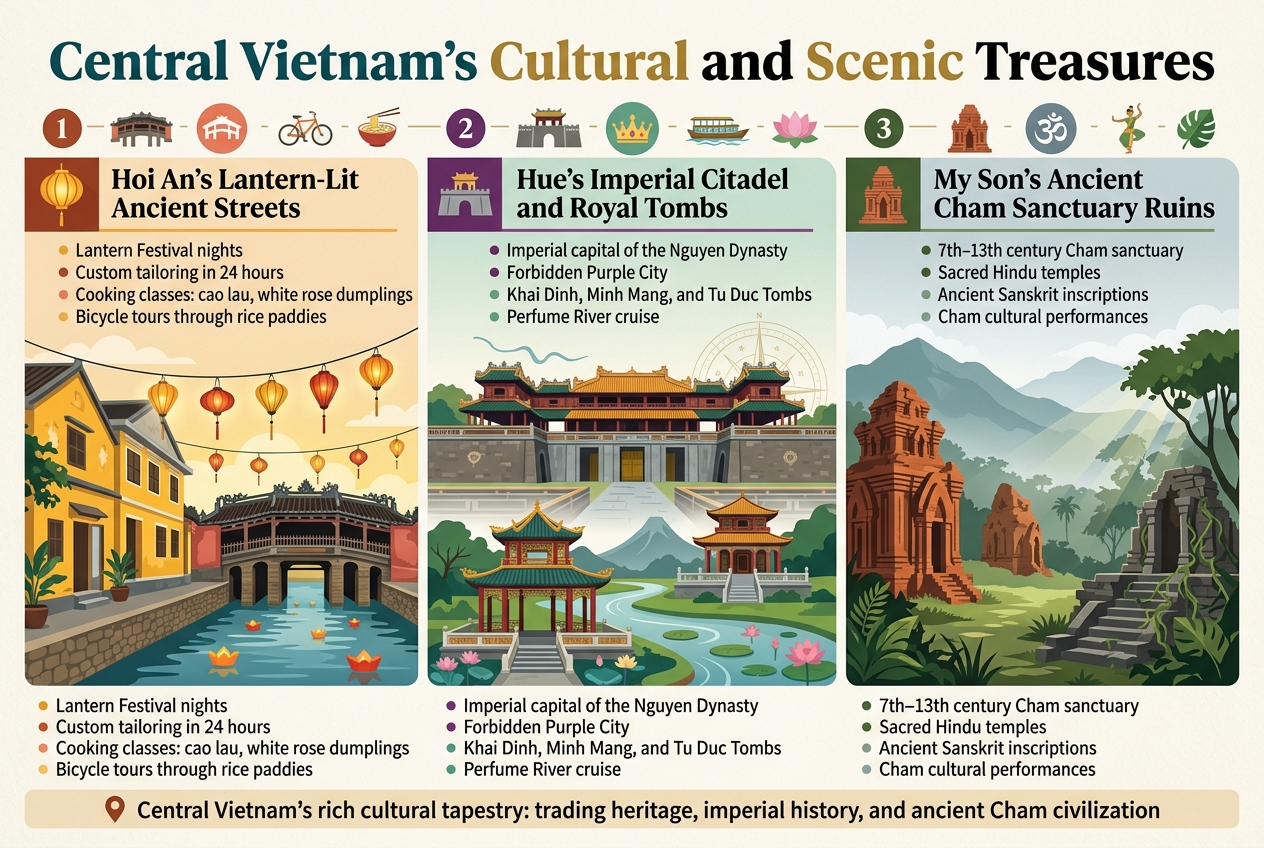
The magic truly begins at sunset when thousands of colorful lanterns illuminate the ancient quarter. These paper and silk lanterns, handcrafted by local artisans, cast a warm glow across Japanese covered bridges, Chinese assembly halls, and French colonial facades. The iconic Japanese Covered Bridge, built in 1593, serves as the town’s symbol and connects the Japanese and Chinese quarters.
Best experiences in Hoi An:
- Lantern Festival nights (14th of each lunar month) when locals release floating lanterns on the Thu Bon River
- Tailor shops along Tran Phu Street offering custom clothing within 24 hours
- Cooking classes featuring local specialties like cao lau noodles and white rose dumplings
- Bicycle tours through surrounding rice paddies and vegetable villages
The town’s culinary scene deserves special attention. Local dishes like cao lau (found nowhere else in Vietnam), fresh spring rolls, and banh mi reflect the multicultural heritage that makes Hoi An such a compelling Vietnam travel destination. Many restaurants occupy restored merchant houses, allowing you to dine surrounded by centuries of history.
Hue’s Imperial Citadel and Royal Tombs
Hue served as Vietnam’s imperial capital for over 140 years, and its legacy remains deeply embedded in elaborate palaces, ornate tombs, and ceremonial halls that showcase the grandeur of the Nguyen Dynasty. The Imperial Citadel, a massive fortress complex, houses the Forbidden Purple City where emperors once lived in complete isolation from the outside world.
The citadel’s architecture reflects classical feng shui principles, with structures positioned to harness positive energy from surrounding mountains and the Perfume River. Despite significant damage during the Vietnam War, restoration efforts have brought much of the complex back to its former glory. The Ngo Mon Gate, with its five entrances representing different social classes, provides a striking introduction to this royal world.
Imperial tombs worth exploring:
- Tomb of Emperor Khai Dinh – Intricate mosaics and European architectural influences
- Tomb of Emperor Minh Mang – Perfect harmony between architecture and natural landscape
- Tomb of Emperor Tu Duc – Romantic setting with lotus ponds and poetry pavilions
The Perfume River cruise offers the most scenic approach to these royal burial sites, winding through countryside dotted with dragon fruit orchards and traditional villages. Each tomb tells a unique story through its design – some reflecting the emperor’s personality, others showcasing the artistic trends of their era.
My Son’s Ancient Cham Sanctuary Ruins
Hidden in a lush valley surrounded by mountains, My Son represents Vietnam’s most significant archaeological site from the ancient Kingdom of Champa. These red brick towers and temples, built between the 7th and 13th centuries, served as the spiritual center for Cham royalty and remain active pilgrimage sites for the Cham people today.
The sanctuary complex originally contained over 70 structures, though war and time have reduced this number to about 20 surviving towers. Each structure was built using techniques that modern engineers still struggle to understand – the Cham people somehow bonded bricks without mortar, creating structures that have withstood centuries of tropical weather and conflict.
What makes My Son special:
- Sacred Hindu temples dedicated to Shiva in his various forms
- Cham cultural performances featuring traditional music and dance
- Ancient Sanskrit inscriptions providing insights into medieval Southeast Asian civilization
- Jungle setting that feels like discovering Angkor Wat before the crowds arrived
The early morning hours offer the best experience at My Son, when mist clings to the surrounding mountains and golden sunlight filters through ancient doorways. Traditional Cham dance performances, held several times daily, bring these silent stones to life with costumes, music, and stories passed down through generations.
These breathtaking places Vietnam offers in its central region showcase the country’s rich cultural tapestry, where ancient Cham kingdoms, Vietnamese imperial dynasties, and international trading communities left their mark on landscapes that continue to captivate travelers from around the world.
Central Highlands’ Mountainous Escapes
Da Lat’s French Colonial Charm and Cool Climate
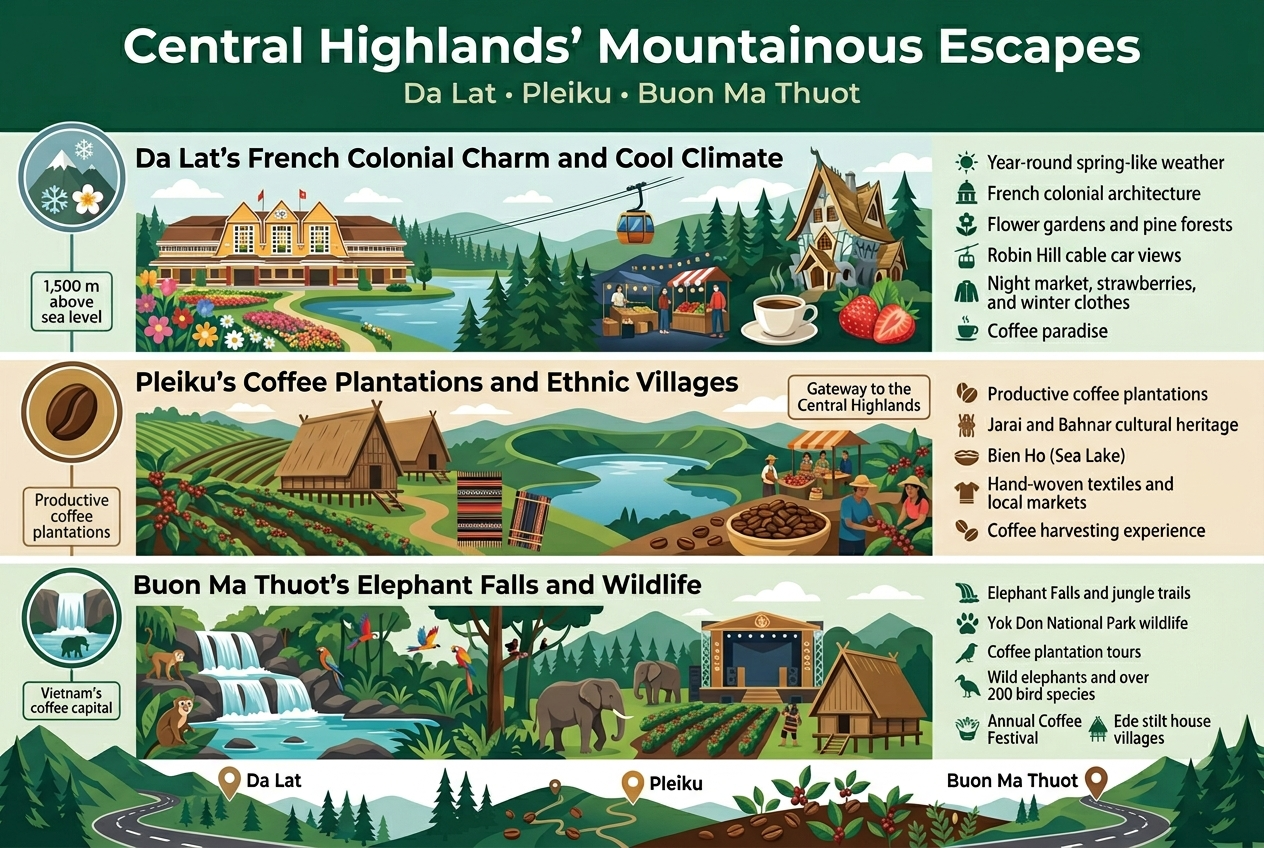
Nestled at 1,500 meters above sea level, Da Lat offers a refreshing escape from Vietnam’s tropical heat. This hill station captivates visitors with its year-round spring-like weather and distinctly European atmosphere. The city’s French colonial architecture tells stories of a bygone era, with the iconic Da Lat Railway Station serving as a perfect example of Art Deco design.
The city’s famous flower gardens burst with vibrant colors throughout the seasons. Xuan Huong Lake provides a peaceful setting for romantic walks, while the surrounding pine forests create an almost Alpine feel. Cable car rides to Robin Hill reveal panoramic views of the valley below, making it one of the top Vietnam destinations for nature lovers.
Da Lat’s bustling night market comes alive after sunset, offering everything from fresh strawberries to warm winter clothes. The nearby Valley of Love and Elephant Falls showcase the region’s natural beauty, while the Crazy House (Hang Nga Guesthouse) stands as one of the world’s most unusual architectural marvels.
Coffee enthusiasts will find themselves in paradise here, as Da Lat produces some of Vietnam’s finest beans. The cooler climate allows for unique varieties that can’t be grown elsewhere in the country, making every cup a memorable experience.
Pleiku’s Coffee Plantations and Ethnic Villages
Pleiku serves as the gateway to the Central Highlands’ rich cultural tapestry and agricultural wonders. The rolling hills surrounding this provincial capital are blanketed with some of Vietnam’s most productive coffee plantations. These vast green expanses produce the robust beans that have made Vietnamese coffee famous worldwide.
The region’s ethnic villages offer authentic glimpses into traditional highland life. The Jarai and Bahnar communities welcome visitors to their longhouses, where ancient customs and modern life blend seamlessly. These communities maintain their unique languages, traditional weaving techniques, and spiritual practices that have been passed down through generations.
Pleiku’s proximity to several stunning crater lakes makes it a perfect base for exploring the region’s volcanic landscape. Bien Ho (Sea Lake) stands out as one of Vietnam’s most pristine natural wonders, surrounded by dense forests and offering crystal-clear waters that reflect the sky like a mirror.
The town itself maintains an authentic feel, with local markets selling everything from hand-woven textiles to freshly harvested coffee beans. Visitors can participate in coffee harvesting during the right season, learning about the entire process from bean to cup while supporting local farmers.
Buon Ma Thuot’s Elephant Falls and Wildlife
Buon Ma Thuot, known as the coffee capital of Vietnam, combines urban sophistication with wild natural beauty. The city serves as the perfect launching point for exploring some of the country’s most spectacular waterfalls and diverse ecosystems.
Elephant Falls (Sekumpul Falls) stands as the crown jewel of the area’s natural attractions. This multi-tiered waterfall cascades down rocky cliffs, creating natural pools perfect for swimming. The surrounding jungle ecosystem supports diverse wildlife, from colorful bird species to playful monkeys that often appear along the hiking trails.
The nearby Yok Don National Park protects one of Vietnam’s largest remaining wilderness areas. This sanctuary houses wild elephants, leopards, and over 200 bird species. Guided tours through the park reveal the incredible biodiversity that makes this region unique among Vietnam tourist attractions.
Coffee culture runs deep in Buon Ma Thuot, with numerous plantations offering tours that explain the cultivation and processing methods that create the region’s famous robust coffee. The annual Coffee Festival celebrates this heritage with traditional performances, coffee competitions, and cultural exchanges.
Local Ede villages near the city showcase traditional stilt houses and provide insights into the spiritual beliefs and daily practices of the highland peoples. These communities have maintained their connection to the land and continue traditional farming methods alongside modern coffee cultivation.
Southern Vietnam’s Tropical Paradise
Mekong Delta’s Floating Markets and River Life
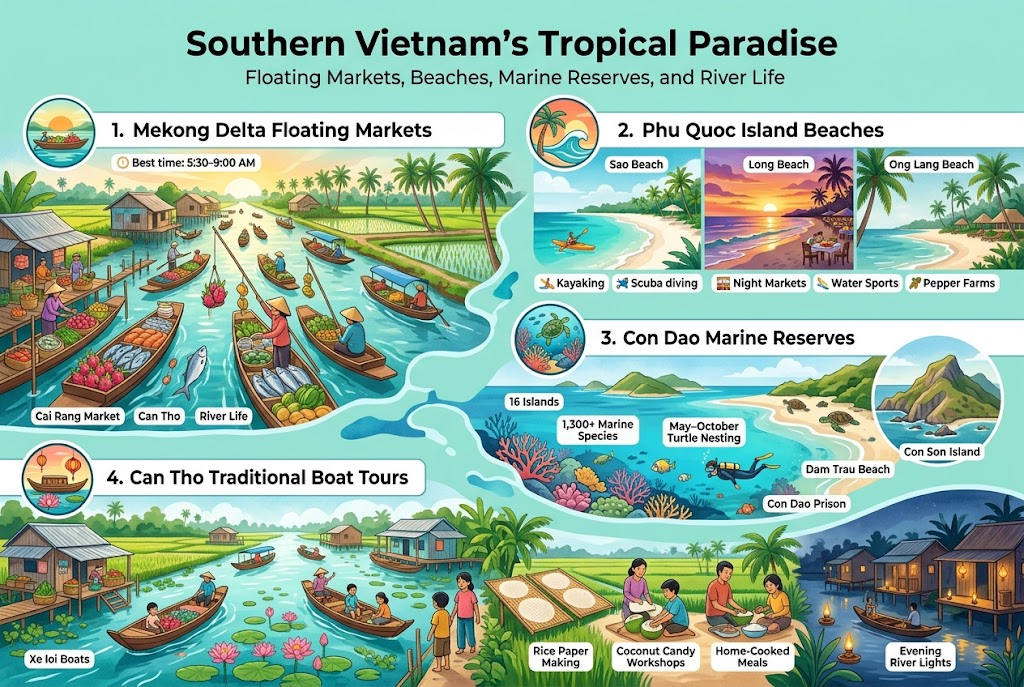
The Mekong Delta pulses with life along its countless waterways, where floating markets have operated for centuries. Cai Rang floating market near Can Tho stands as the region’s crown jewel, drawing visitors before dawn to witness vendors selling everything from dragon fruit to fresh fish directly from their boats. The best time to experience this authentic slice of Vietnamese culture is between 5:30 and 9:00 AM when activity peaks.
Local vendors hang sample products on long poles above their boats, creating a colorful display that attracts buyers navigating the maze of canals. Beyond the markets, the delta’s intricate network of rivers and tributaries reveals traditional stilt houses, rice paddies stretching to the horizon, and coconut groves lining muddy banks. Many families still depend entirely on river life, using boats for transportation, commerce, and daily activities.
The delta’s unique ecosystem supports countless species of fish, birds, and plants that have adapted to the seasonal flooding cycles. Visitors can explore narrow canals by sampan, stopping at local homes to taste fresh tropical fruits and learn traditional crafts like rice paper making and coconut candy production.
Phu Quoc Island’s White Sand Beaches
Phu Quoc Island emerges from the Gulf of Thailand as Vietnam’s premier beach destination, boasting some of Asia’s most stunning coastlines. Sao Beach captures hearts with its powdery white sand that squeaks beneath your feet and crystal-clear turquoise waters perfect for swimming year-round. The beach stretches for nearly five kilometers, offering plenty of space even during peak season.
Long Beach provides a different vibe with its vibrant sunset scene and beachfront restaurants serving fresh seafood caught that morning. The western coast catches the most spectacular sunsets in Vietnam, painting the sky in brilliant oranges and purples each evening. Ong Lang Beach appeals to those seeking tranquility, with fewer crowds and several eco-friendly resorts nestled among swaying palms.
The island’s beaches offer excellent conditions for various water sports, from kayaking through mangrove forests to scuba diving at nearby coral reefs. Pepper farms and fish sauce factories dot the inland areas, giving visitors glimpses into local industries that have shaped island culture for generations. Night markets in Duong Dong town buzz with activity, featuring grilled seafood, tropical fruits, and handmade souvenirs.
Con Dao Islands’ Pristine Marine Reserves
Con Dao archipelago remains one of Vietnam’s best-kept secrets, comprising 16 islands surrounded by protected marine reserves. The crystal-clear waters harbor vibrant coral reefs, sea turtles, and over 1,300 marine species that thrive in this relatively untouched environment. Green and hawksbill turtles nest on several beaches between May and October, creating unforgettable wildlife encounters for lucky visitors.
Dam Trau Beach offers pristine white sand and excellent snorkeling opportunities right from shore. The marine park’s strict conservation efforts have preserved coral gardens that explode with color and life, making every dive or snorkel session feel like exploring an underwater wonderland. Dugongs occasionally grace these waters, along with reef sharks and countless tropical fish species.
Con Son Island serves as the main hub, featuring the historic Con Dao Prison that tells stories of Vietnam’s revolutionary past. The island’s mountainous interior provides hiking trails through tropical forests where rare endemic species find shelter. Luxury resorts have recently opened while maintaining strict environmental standards, allowing visitors to experience this paradise without damaging its delicate ecosystems. The islands’ remote location keeps crowds minimal, preserving the sense of discovery that makes Con Dao special.
Can Tho’s Traditional Boat Tours
Can Tho serves as the Mekong Delta’s unofficial capital, offering authentic boat tours that reveal the region’s traditional way of life. Local guides navigate narrow channels lined with water hyacinth and lotus flowers, leading visitors to fruit orchards, rice mills, and family-run workshops. These intimate tours provide genuine cultural exchanges away from tourist crowds.
Traditional wooden boats called “xe loi” transport visitors through a maze of canals where daily life unfolds at water level. Floating houses, fishing nets, and children swimming in muddy waters create scenes that have remained unchanged for decades. Local families often invite visitors into their homes for home-cooked meals featuring Mekong specialties like elephant ear fish and fresh spring rolls.
The tours typically include stops at traditional industries like rice paper production, where families stretch thin sheets of batter on bamboo mats under the tropical sun. Coconut candy workshops demonstrate age-old techniques passed down through generations. Evening boat rides become magical as oil lamps flicker on stilt houses and the sounds of river life create a natural soundtrack. Many tours end at local restaurants built over the water, where diners can enjoy fresh fish while watching the delta’s endless waterways flow beneath their feet.
Hidden Gems Off the Beaten Path
Phong Nha’s Underground River Systems
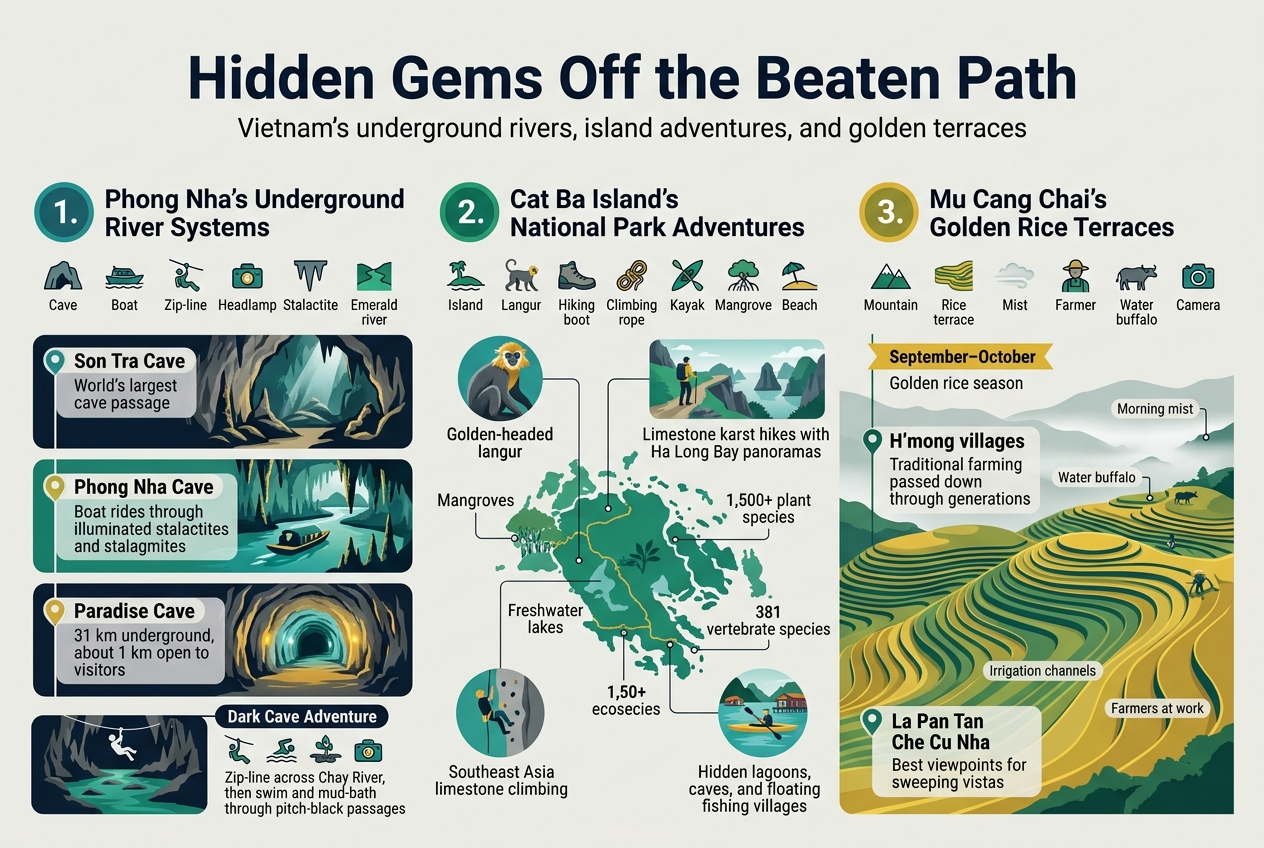
Phong Nha-Ke Bang National Park hides some of Vietnam’s most spectacular underground worlds, where ancient limestone formations have created a network of caves and underground rivers that will leave you speechless. The crown jewel here is Son Tra Cave, home to the world’s largest cave passage, which feels like stepping into another planet entirely.
Phong Nha Cave itself offers boat rides through its underground river system, where stalactites and stalagmites create natural cathedrals illuminated by carefully placed lights. The journey takes you deep into the earth, floating on emerald waters while limestone formations tower overhead like frozen waterfalls. Paradise Cave stretches for over 31 kilometers underground, though visitors can explore about one kilometer of this breathtaking subterranean wonderland.
For adventure seekers, the Dark Cave provides an entirely different experience – you’ll zip-line across the Chay River, then swim and mud-bath your way through pitch-black passages using only headlamps for guidance. These Vietnam hidden gems offer experiences you simply can’t find anywhere else on Earth, making Phong Nha one of the most unique Vietnam travel destinations for those seeking something truly extraordinary.
Cat Ba Island’s National Park Adventures
Cat Ba Island presents a perfect blend of pristine wilderness and coastal beauty that makes it stand out among Vietnam’s best places to visit. The national park covers nearly half of the island, protecting rare species like the golden-headed langur – one of the world’s most endangered primates with fewer than 70 individuals remaining in the wild.
Hiking trails wind through tropical forests and limestone karst formations, leading to viewpoints that offer stunning panoramas of Ha Long Bay’s emerald waters. The park’s diverse ecosystems range from mangrove swamps to freshwater lakes, creating habitats for over 1,500 plant species and 381 vertebrate species.
Rock climbing enthusiasts flock here for some of Southeast Asia’s best limestone climbing, with routes suitable for beginners and experts alike. The island’s beaches provide perfect spots to unwind after outdoor adventures, while floating fishing villages offer glimpses into traditional Vietnamese coastal life. Kayaking through hidden lagoons and caves reveals secluded beaches accessible only by water, making every exploration feel like discovering your own private paradise.
Mu Cang Chai’s Golden Rice Terraces
Between September and October, Mu Cang Chai transforms into a golden masterpiece that rivals any Vietnam scenic spots you’ll find elsewhere in the country. These ancient rice terraces, carved into mountainsides by H’mong farmers over centuries, create layers upon layers of shimmering gold that cascade down the valleys like giant steps to heaven.
The terraces follow the natural contours of the mountains, creating organic patterns that change with the light throughout the day. Early morning mist rises from the valleys, adding an ethereal quality to the already magical landscape. Local H’mong villages dot the mountainsides, where families still farm using traditional methods passed down through generations.
Photography enthusiasts consider this one of the top Vietnam destinations for capturing stunning landscapes, but the beauty here goes beyond what any camera can capture. Walking the narrow paths between terraces, you’ll encounter farmers tending their crops, water buffalo cooling off in irrigation channels, and children playing among the golden stalks. The best viewpoints include La Pan Tan and Che Cu Nha, where sweeping vistas reveal the full extent of this agricultural artwork. These terraced landscapes represent not just natural beauty, but centuries of human harmony with the environment, making Mu Cang Chai a true testament to sustainable farming practices and cultural preservation.
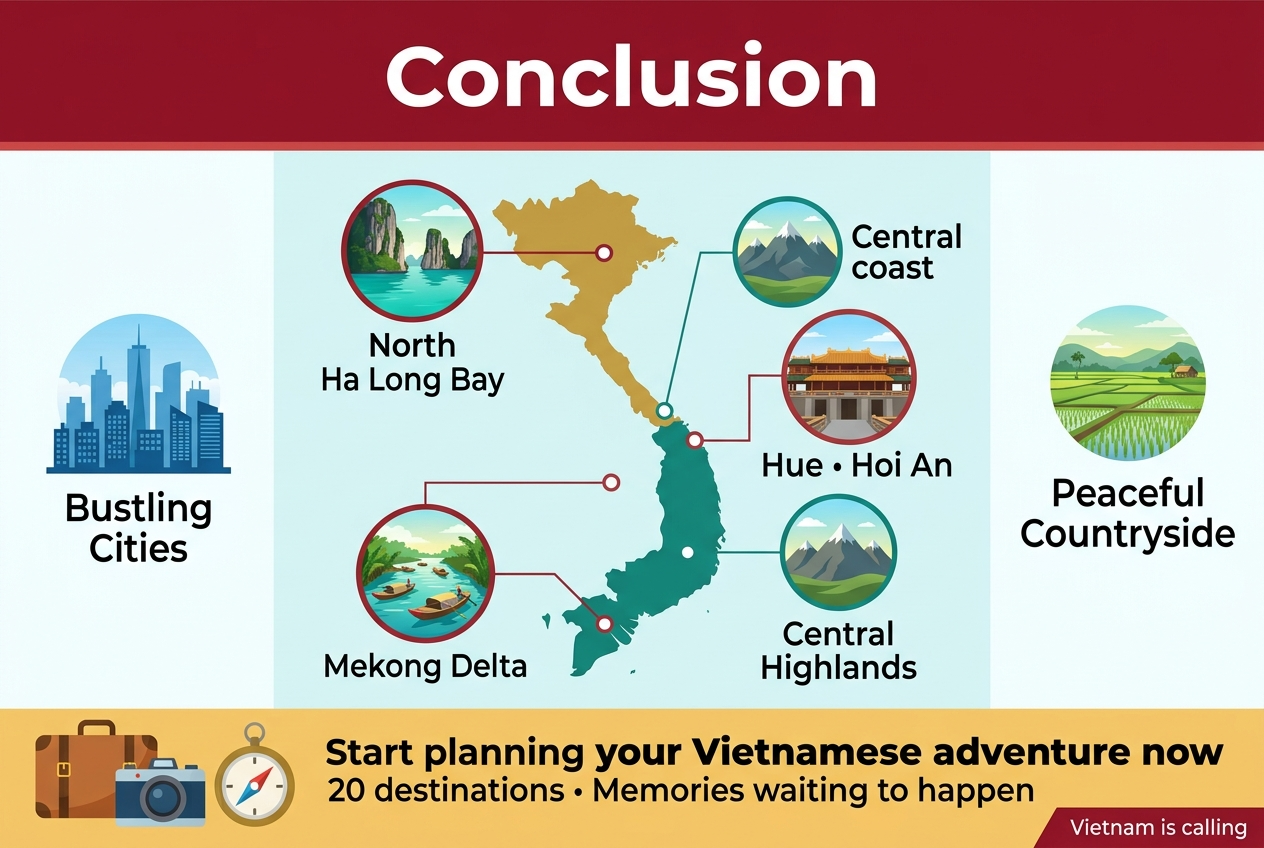
Vietnam offers an incredible mix of landscapes and experiences that will leave you speechless. From the dramatic limestone cliffs of Ha Long Bay in the north to the floating markets of the Mekong Delta in the south, each region brings its own magic. The Central Highlands give you that perfect mountain escape, while the cultural treasures around Hue and Hoi An show off Vietnam’s rich history. Whether you’re drawn to bustling cities or peaceful countryside, Vietnam has something special waiting for you.
Start planning your Vietnamese adventure now – these 20 destinations aren’t just places on a map, they’re memories waiting to happen. Pack your camera, bring your sense of wonder, and get ready to fall in love with one of Southeast Asia’s most captivating countries. Vietnam is calling, and trust us, you’ll want to answer.


